
Water spots on granite usually show up when you're already behind. You wipe down the kitchen in Boca Raton or Jupiter, the counters look clean, and then the light hits a hazy ring near the sink or a darker mark under a soap bottle. In Palm Beach County, that happens fast because humidity hangs around, AC condensation is constant, and water doesn't always evaporate cleanly.
This guide is for homeowners, renters, Airbnb hosts, and property managers who want counters that look polished now, not after trial and error. If you're comparing cleaning help in West Palm Beach and the surrounding area, this is the practical version of what works, what doesn't, and when water spots on granite turn into a bigger stone-care issue.
Table of Contents
- Why Granite Gets Water Spots in Palm Beach County
- Diagnosing Your Granite Problem The Right Way
- Safe DIY Methods for Light Water Spots
- Preventing Granite Water Spots in South Florida
- When DIY Is Not Enough and Its Time to Call Us
Why Granite Gets Water Spots in Palm Beach County
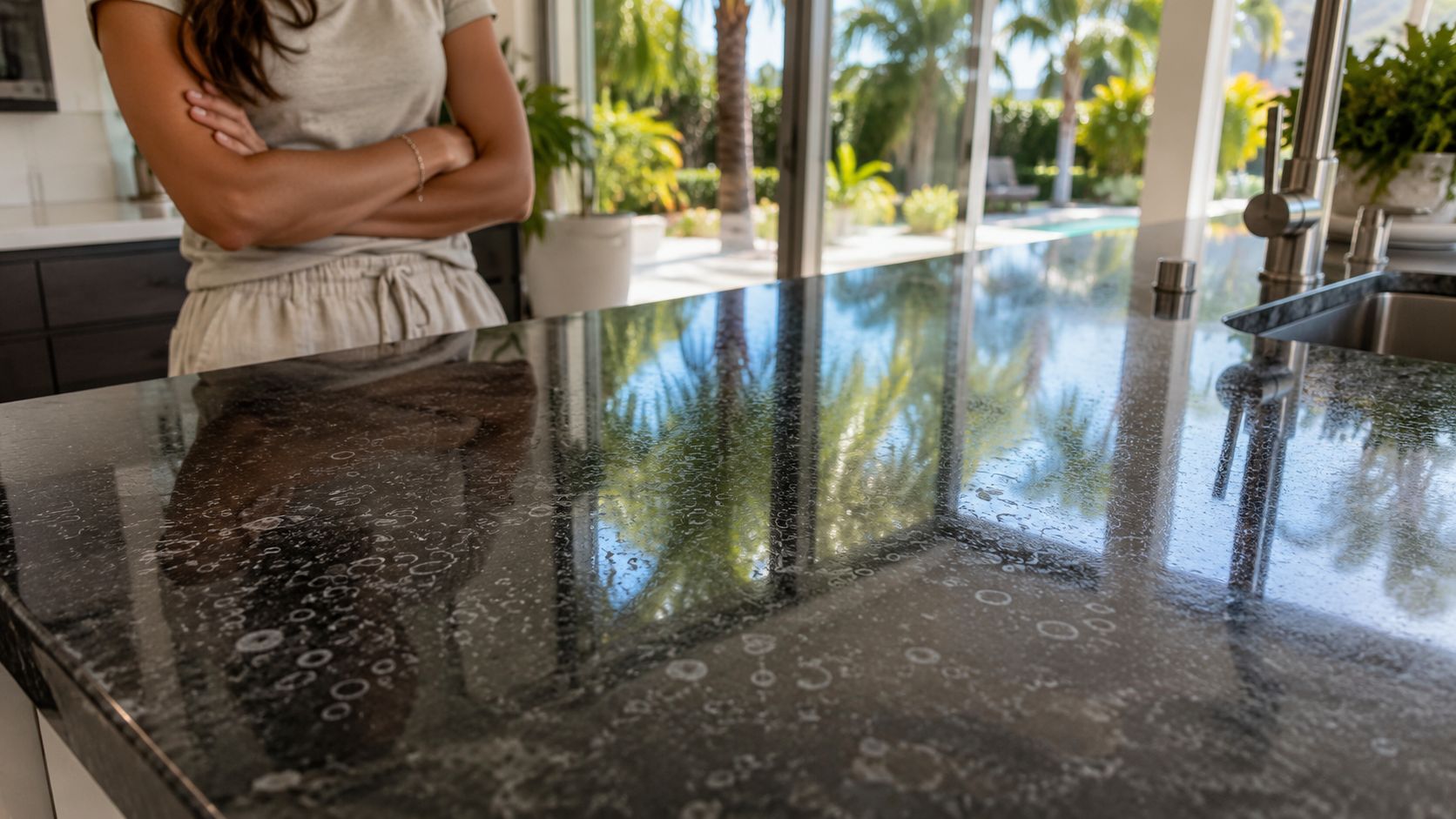
In Palm Beach County, water spots on granite aren't just a housekeeping annoyance. They're a local wear pattern. In coastal homes from Juno Beach to Delray Beach, counters deal with humid air, salty residue near open sliders, and lots of sink traffic from year-round cooking, entertaining, and quick cleanups before guests arrive.
What the spot is actually telling you
Some marks are simple mineral deposits. Standing water can leave behind calcium and magnesium, especially when hard water dries on the surface. Light, hazy rings near faucets, dish racks, and soap dispensers often fall into that category.
Other marks point to a bigger issue. Data shows that 60-70% of granite staining in major markets like Florida is root-caused by sealant degradation from acidic cleaners or hard water minerals, not just surface grime, as noted in this granite stain analysis for Florida markets.
A ring that keeps returning after normal wiping usually isn't asking for more elbow grease. It's asking for a better diagnosis.
Palm Beach County conditions make it worse
Local kitchens put granite through a lot. Condensation from cold drinks forms quickly in air-conditioned homes. Salt air in coastal communities can wear on finishes over time. Humidity also slows drying, which gives mineral residue more time to settle.
That same moisture pattern shows up elsewhere in the home too. If your house tends to hold damp air, it's worth understanding what causes indoor humidity in South Florida homes because countertop spotting rarely happens in isolation.
Water spot or etch mark
Many homeowners get tripped up:
- Water spot – Usually looks cloudy, chalky, or ring-shaped
- Sealer mark – Often appears as a light outline where water dried
- Etching – Usually looks dull and may feel rougher than the surrounding polish
Etching isn't the same as a mineral deposit. If the surface has lost shine in one exact area, cleaning alone may not fix it. That's one reason generic internet advice misses the mark in Palm Beach County homes. The local problem isn't just water. It's water plus humidity, hard minerals, and sealers that don't age well in busy South Florida kitchens.
Diagnosing Your Granite Problem The Right Way
Before scrubbing anything, test the countertop. A lot of failed DIY attempts happen because the wrong problem gets treated. The ring looks like surface buildup, but the stone is absorbing moisture, or the sealer itself is what's showing the mark.
Use the water test first
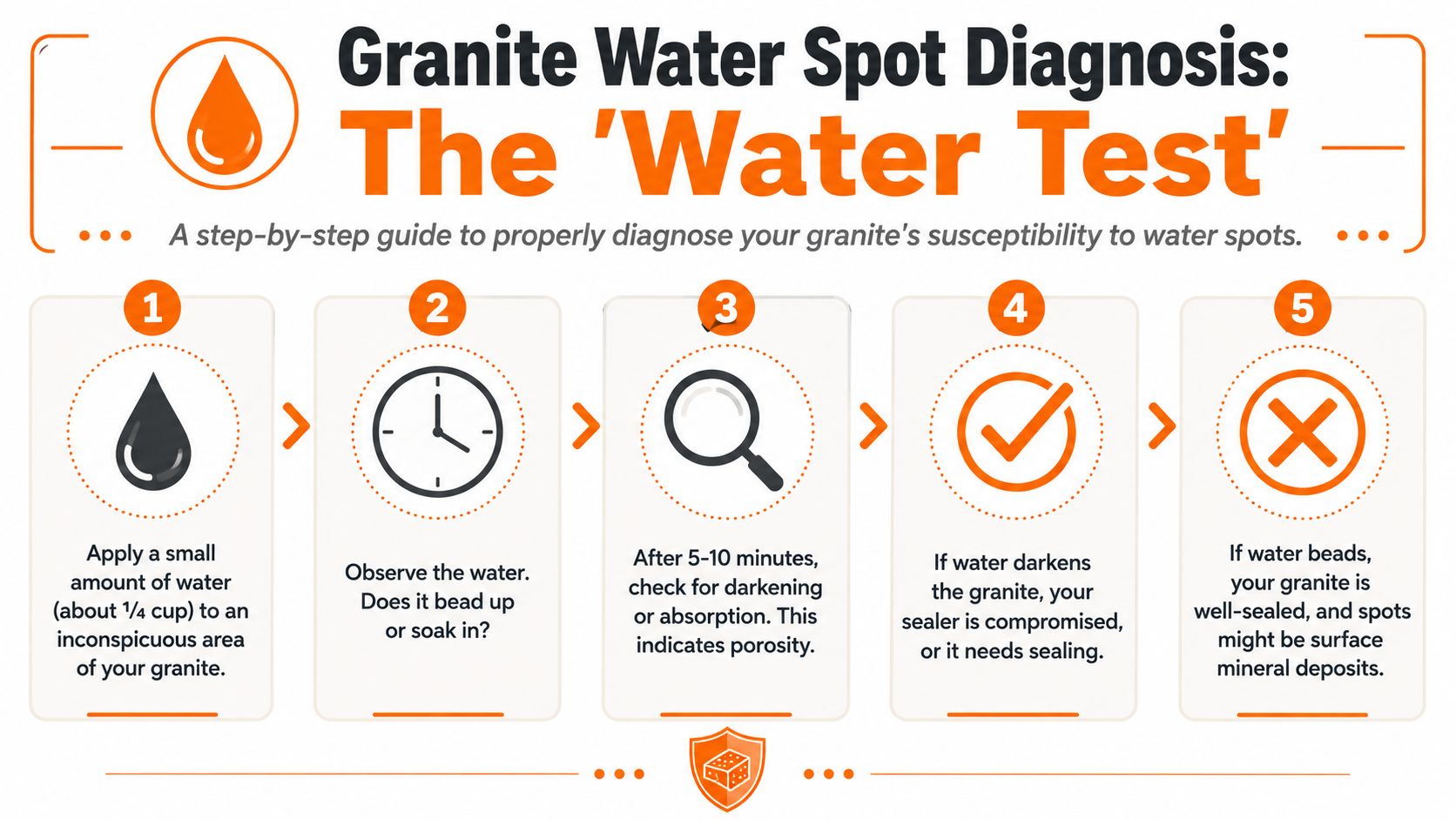
The simplest on-site check is the water test. It tells you whether you're dealing with a healthy surface, a failing sealer, or a porous area that needs more than spot cleaning.
- Place a few drops of water on the problem area.
- Place a few drops on a clean area nearby.
- Let the water sit briefly and watch what happens.
- Check whether it beads on top or darkens the stone.
- Wipe dry and compare both spots.
If the water beads, the issue may be a surface deposit. If the water darkens the granite, the stone or sealer is taking it in.
Practical rule: Don't apply a poultice until you know whether the counter is resisting water or absorbing it.
What the results usually mean
A quick comparison helps:
| Result | Likely issue | Best next move |
|---|---|---|
| Water beads up | Surface mineral film | Try a gentle cleaning method |
| Water darkens the area | Sealer is compromised or stone is porous | Treat carefully and consider professional help |
| Light outline remains after drying | Mark may be on the sealer layer | Avoid aggressive scrubbing |
One nuance many homeowners miss is that water stains on granite are often caused because the granite was sealed unnecessarily, meaning the water is marking the sealer layer rather than the stone itself, which results in a light outline of where the water dried, as discussed in this Houzz discussion on sealer-layer water marks.
What we see in Palm Beach County homes
In Wellington and Westlake kitchens, darker counters near the sink often show a faint halo where dish soap, hard water, and moisture sit in the same place every day. In Loxahatchee homes, some dense darker granites don't behave like the softer, more absorbent slabs you see elsewhere. That's why one counter may need resealing while another only needs the residue removed from the top layer.
If you're trying to tell whether you're seeing streaking, film, or true stone discoloration, the same habit that helps with glass helps here too. Good light, a clean dry cloth, and the right angle matter. The approach is similar to what makes mirror cleaning without haze or streaks more accurate.
Safe DIY Methods for Light Water Spots
A light ring from a cold glass is one thing. A chalky patch beside the faucet in a Palm Beach County kitchen is often something else, especially when hard municipal water dries on warm stone day after day. Start with the mildest method because polished granite usually gets damaged by the fix, not the spot.
Start with the least aggressive method
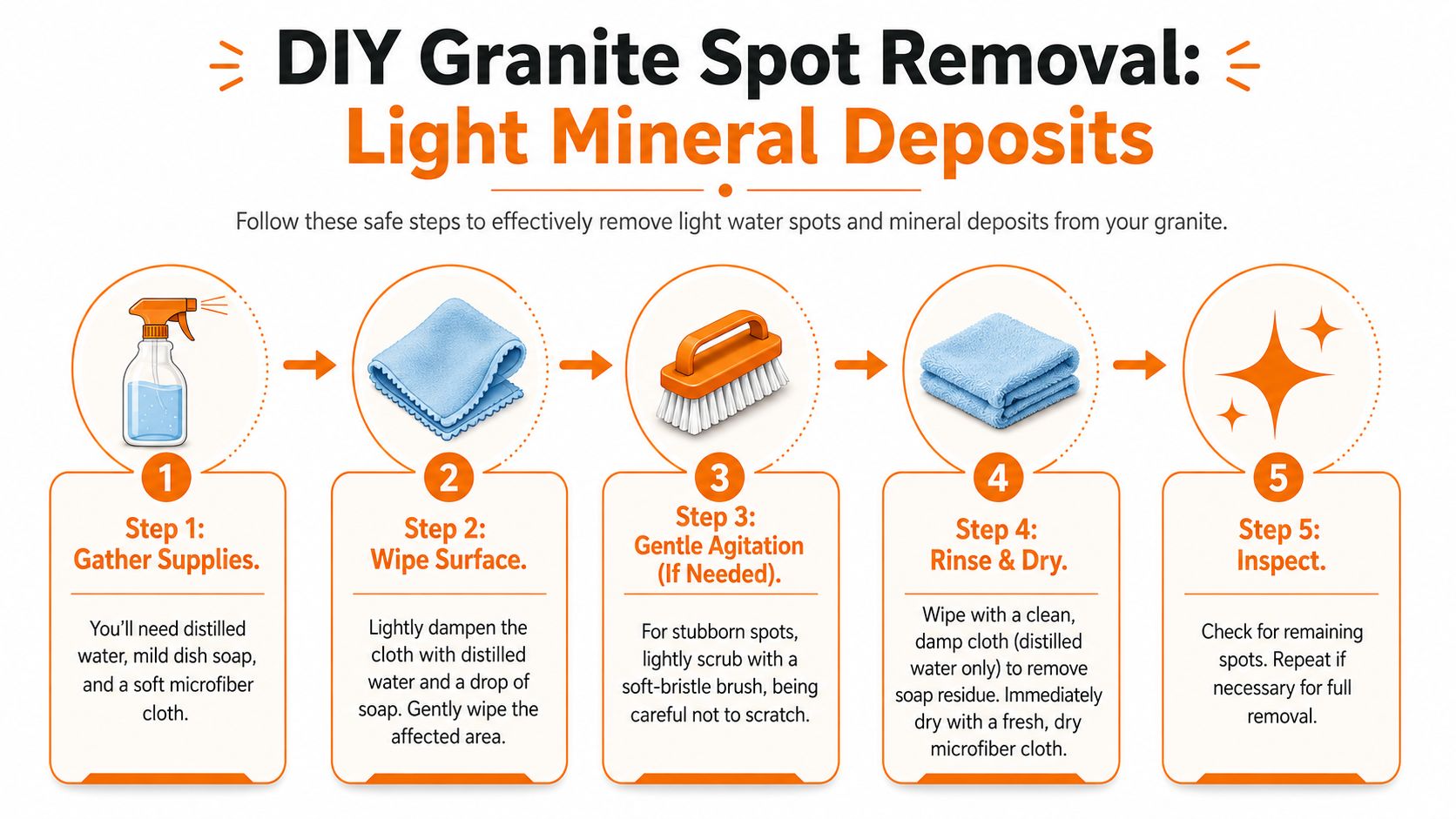
For fresh surface marks, clean the area with warm water, a few drops of mild dish soap, and a soft microfiber cloth. If greasy residue is mixed in with the water spot, add a small amount of rubbing alcohol to the cloth, not directly to the counter, and keep the contact brief. Too much alcohol can affect some sealers.
Wipe in small circles with light pressure. Then buff the area dry right away. In humid coastal homes, letting water air-dry on granite often puts the minerals back in the same place you just cleaned.
A simple first pass usually works best for:
- fresh condensation rings
- cloudy film near a faucet
- light spotting around soap dispensers
- residue sitting on top of the finish
Baking soda paste for light rings
If the mark is still visible but looks shallow, use baking soda and water to make a soft paste. Spread a thin layer over the spot, leave it for 5 to 10 minutes, then loosen it gently with a soft-bristled brush or folded microfiber cloth. Rinse well and dry completely.
Keep the dwell time short. Baking soda is mild, but scrubbing too long on polished granite can leave the finish looking uneven under window light.
If the ring fades after one short treatment, you are dealing with residue close to the surface. If it stays the same after two careful tries, stop there. At that point the issue may be below the surface, trapped in a failing sealer layer, or tied to etching on a neighboring material such as marble trim or a mixed-stone backsplash.
Homeowners often ask if a general household spray will do the same job. Granite responds better to low-residue products and soft towels than to multipurpose cleaners that leave a film behind. The same habit of choosing low-residue, non-toxic cleaners that do not leave buildup on household surfaces carries over here.
For deeper marks, use a real poultice
When a spot has soaked past the surface film, a quick wipe will not pull it out. Use a poultice made from baking soda and 3% hydrogen peroxide. Apply it about 1/4 inch thick, cover it with plastic wrap with small holes, and let it sit for 24 to 48 hours.
This method achieves an 85-90% success rate on stains absorbed into the stone when used properly, based on this granite poultice method reference.
A video can help if you've never seen the process laid out visually:
A poultice is slower, messier, and more exact than the internet usually makes it sound. It can help on isolated marks, but it will not solve a whole counter that is spotting because the sealer has broken down across the sink run. We see that often in Palm Beach Gardens condos and coastal homes where salt air, indoor humidity, and frequent wiping wear the finish unevenly.
What not to use
Avoid products and tools that create a second problem while you are trying to remove the first one:
- No vinegar or lemon. Acid can dull the finish.
- No abrasive powder cleaners. They can scratch polished granite.
- No rough scrub pads. The stone is hard, but the polish still shows wear.
- No bathroom descalers or lime removers. Many are too aggressive for natural stone.
- No repeated DIY cycles on the same spot. If two careful attempts do not change it, stronger chemistry usually makes professional restoration more likely.
Recent surface spotting is the best DIY candidate. Older marks near sinks, dish racks, coffee stations, and windows tend to be more stubborn in South Florida because mineral content, moisture in the air, and sealer wear all stack up in the same areas.
Preventing Granite Water Spots in South Florida
A Palm Beach County granite top can look clean at night and show fresh rings, haze, or dull drip marks by the next morning. That is common here because the problem is rarely just "water." It is hard municipal water, constant indoor humidity, coastal salt exposure in some homes, and sealers that wear out faster around sinks and high-use areas.
Sealers don't last forever
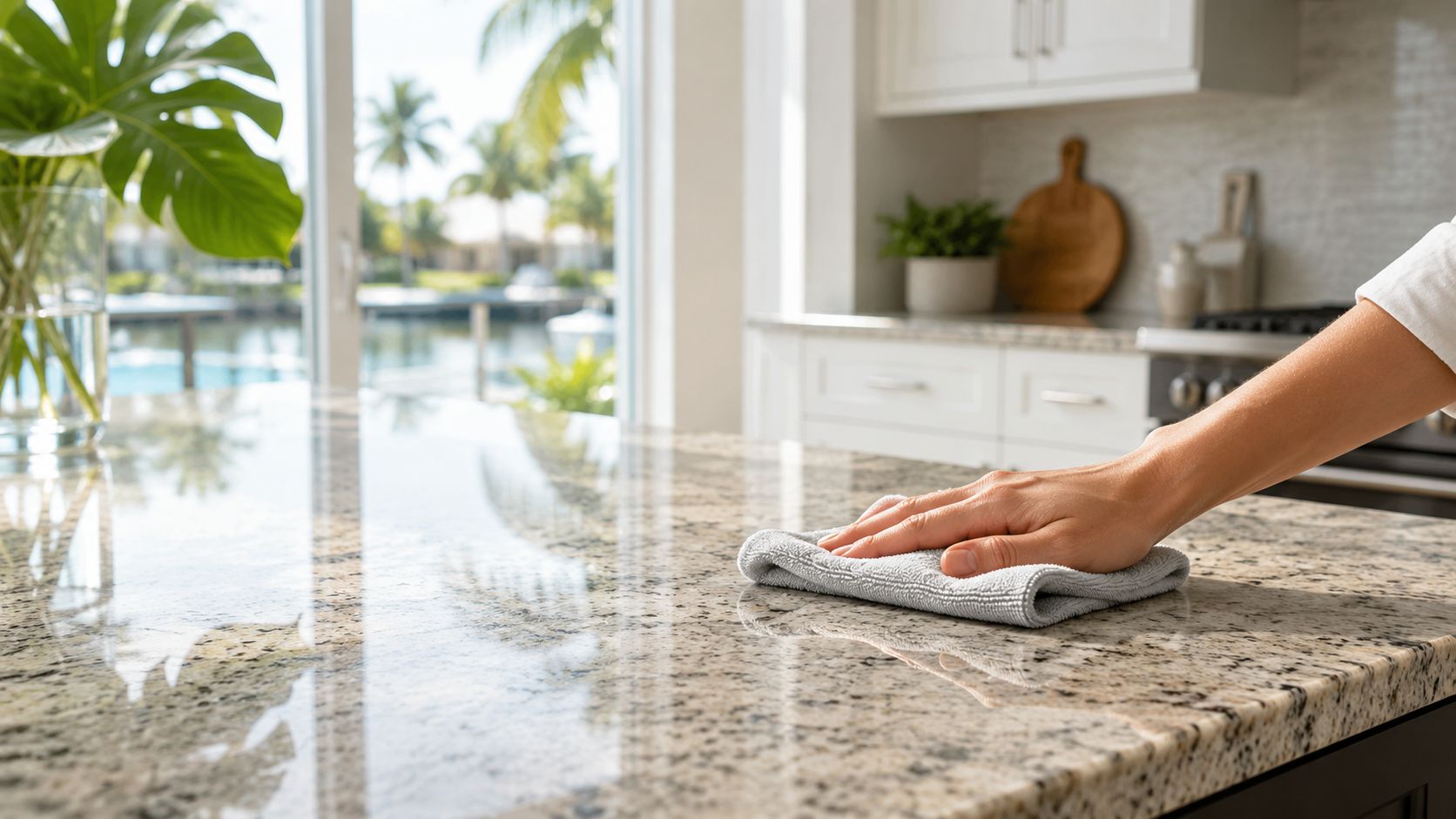
Granite sealer is a maintenance item, not a one-time fix. The BC Stone guide on granite water stain prevention notes that sealers weaken over time, and wet environments often need more frequent resealing.
That matches what we see in Palm Beach County. The first areas to lose protection are usually the sink run, the stretch by the coffee maker, and any section that gets wiped over and over with water but not dried. In coastal condos, salt in the air can add wear to the finish cycle. In inland homes, hard tap water and daily kitchen traffic are usually the bigger issue.
A quick test helps. Put a few drops of water on a clean section of granite and wait several minutes. If the stone darkens fast, the sealer is no longer giving you much margin for error.
Daily habits that help
Prevention comes down to reducing contact time and mineral buildup:
- Dry the counter after wiping it down. Cleaning without drying still leaves minerals behind.
- Use a microfiber cloth instead of a sponge alone. Microfiber removes residue better and leaves less water sitting on the surface.
- Keep trays under soap bottles, oil bottles, and coffee gear. These spots trap moisture and create the same rings week after week.
- Wipe under dish racks and drying mats. Water collects underneath long before the top surface looks wet.
- Use coasters for cold drinks. In air-conditioned homes, condensation forms fast.
One habit matters more than people expect. Drying the granite is what prevents many spot complaints, especially near the sink.
What We See in Palm Beach County Homes
The repeat problem areas are predictable. In Boynton Beach and Delray Beach kitchens, spotting often starts where filtered water drips, where kids set down lunch containers, or where a soap dispenser sits in one place for months. In Jupiter and coastal high-rises, we also see counters that have uneven protection because humidity, salt air, and strong sunlight near sliders wear surfaces differently across the same slab.
That is why prevention is not just a cleaning routine. It is a maintenance routine that matches the house, the water, and the way the kitchen gets used.
If spots keep returning in the same places even after better habits, the issue is often beyond surface cleanup. At that point, resealing, finish correction, or a professional inspection usually makes more sense than repeating the same DIY steps.
When DIY Is Not Enough and Its Time to Call Us
Some counters respond well to careful DIY. Others don't. If the spot feels rough, looks dull instead of chalky, covers a broad dark area, or keeps reappearing after gentle cleaning, the issue may be beyond surface residue.
Signs you're past the DIY stage
Call for help when you notice any of these:
- The counter darkens quickly during a water test across more than one area
- The mark is dull, not cloudy and the finish looks damaged
- A poultice made no difference after proper use
- You manage a rental or Airbnb and can't wait out a long treatment
For an Airbnb host in Riviera Beach with a same-day turnover, gambling on a 24 to 48 hour poultice isn't practical. The same goes for a move-out clean in West Palm Beach where the kitchen has to look inspection-ready that day, not two days from now.
What a professional visit should look like
A solid service process is simple:
- Schedule – Book online or call and get a clear confirmation window
- Clean – The team arrives with supplies and follows a checklist-based clean
- Inspect – A quick quality check catches residue, haze, and missed edges
- Enjoy – You come back to a cleaner home without guessing what product is safe
If you're booking a full cleaning visit, most clients want the surrounding areas handled too, not just the countertop. That usually includes bathrooms, kitchen degreasing, floors, baseboards, dust removal, mirrors, high-touch disinfecting, cabinet exteriors, sinks, counters, fixtures, and window sills. Common add-ons include inside oven, fridge, cabinets, wall spot cleaning, pet-hair focus areas, and interior window cleaning.
Quick FAQ
How long does it take?
It depends on the home's size, condition, and whether you're booking standard, deep, turnover, or move-out cleaning.
Are supplies included?
Yes. A professional team should arrive with its own cleaning supplies and tools.
Can you work around pets or guests?
Yes. That comes up all the time in Palm Beach County homes, rentals, and occupied properties.
What does pricing look like?
Pricing depends on bedrooms, bathrooms, square footage, condition, and add-ons. Most clients request a custom estimate.
South Florida humidity shows up on stone, grout, mirrors, and bathroom ceilings faster than expected. In Palm Beach County homes, the difference between a clean-looking kitchen and a polished one is usually the detail work around moisture.
Book your cleaning with Sunset Shine Home Cleaning – your trusted house cleaning service in West Palm Beach for homeowners, renters, Airbnb hosts, and property managers dealing with water spots on granite, humidity, turnover pressure, and everyday buildup. Call 561-408-4020 or book online at sunsetshinehomecleaning.com.