
You've finished the renovation, the contractor has left, and the Palm Beach County home looks ready. Then sunlight catches a gray film on the baseboards, fine dust appears on the window tracks, and the AC sends another layer across the kitchen. How to clean up dust from construction matters because drywall dust, grout haze, adhesive residue, and possible silica particles require more than a quick vacuum pass.
Sunset Shine Home Cleaning handles post-construction cleaning across West Palm Beach and Palm Beach County for homeowners, renters, Airbnb hosts, contractors, and property managers who need a move-in ready home, guest-ready rental, or clean space before a landlord walkthrough. The process addresses the local combination of year-round AC dust, high humidity, tropical pollen, sand, and rainy-season mud.
Table of Contents
- Why Post-Construction Dust Lingers in South Florida Homes
- Safety and Preparation Before You Start Cleaning
- Choosing the Right Tools and Supplies for Dust Removal
- The Top-Down Cleaning Sequence That Actually Works
- Managing HVAC Systems and Hidden Dust Zones
- When Construction Dust Becomes a Health Hazard
- When to Hire Professional Post-Construction Cleaners
Why Post-Construction Dust Lingers in South Florida Homes
A freshly remodeled Palm Beach Gardens condo can look spotless at noon and still show dust on the coffee table by evening. The rough debris may be gone, but fine particles remain in vent covers, cabinet toe kicks, grout lines, window tracks, and the small gaps along baseboards.

South Florida homes have a particular recontamination problem. Air conditioning runs through much of the year, so unprotected returns and supply vents can move fine dust from a renovation zone into occupied rooms. High humidity also makes residue cling to shower grout, window channels, cabinet interiors, and freshly installed tile. In coastal homes, salt air and tracked beach sand add another layer to fixtures and floors.
Fine dust needs a different approach
Large scraps, packaging, nails, and chunks of drywall belong in the rough-clean phase. Fine drywall dust is different. A standard vacuum may release particles through its exhaust, while dry sweeping or aggressive dusting can put settled material back into the air.
OSHA's construction silica standard treats respirable dust as an exposure-control issue. It sets an action level of 25 μg/m³ and a permissible exposure limit of 50 μg/m³, both measured as an 8-hour time-weighted average, and restricts dry sweeping, dry brushing, and compressed air when they could increase exposure. OSHA's construction silica guidance also connects source controls, written plans, competent-person oversight, and training with cleanup practices.
For a useful visual overview of the overall workflow, review this step-by-step clean up process. In a humid home, the order matters just as much as the products. Homeowners can also review what causes humidity in a house before deciding how to manage ventilation.
Safety and Preparation Before You Start Cleaning
Before disturbing construction dust, identify what was disturbed and protect the people, finishes, and HVAC system. A minor drywall refresh is not the same as concrete cutting, tile grinding, work around old painted surfaces, or demolition in an older Palm Beach County home.
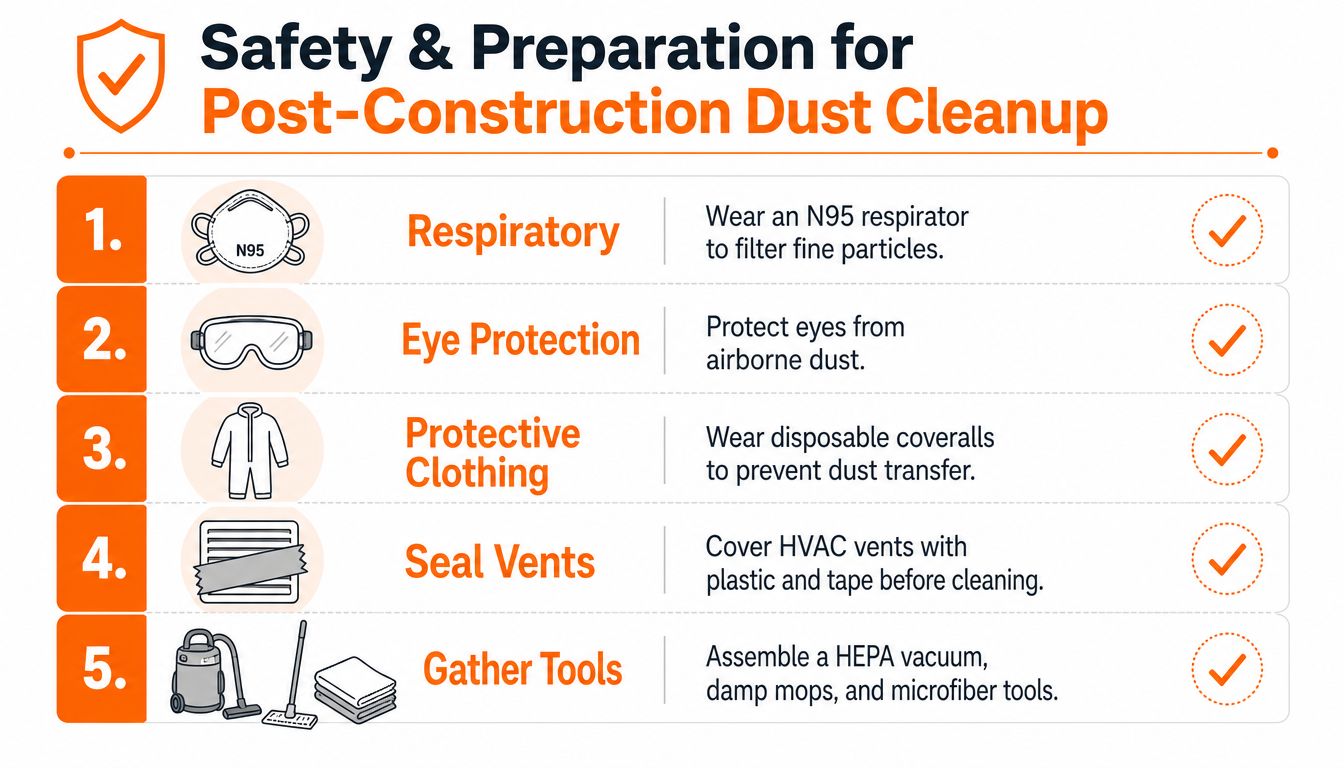
Prepare the work zone
Wear an N95 or better respirator, eye protection, gloves, and clothing that can be removed before entering clean rooms. Higher-risk materials call for qualified professionals and appropriate respiratory protection, not a casual household cleanup.
Shut down HVAC serving the work area when practical, or isolate the zone. Cover supply and return grilles with plastic and tape, close doors, and use plastic sheeting to create a containment boundary. Zip-wall systems are useful when renovation dust is concentrated in one room, especially in open-plan West Palm Beach homes where the kitchen, living room, and hallway share one air path.
Opening windows can help in some conditions, but it isn't automatically wise during humid weather, heavy tropical pollen, or rainy-season storms. A portable air scrubber with true HEPA filtration can be more controlled, particularly when the home is occupied.
Practical rule: Don't create airflow through clean rooms until the dusty area is contained and the HVAC path is protected.
Quick preparation check
- Identify materials: Ask the contractor whether work involved concrete, masonry, tile, lead paint, or suspected asbestos.
- Protect finishes: Confirm cleaning products are compatible with quartz, luxury vinyl plank, natural stone, wood, and fresh paint.
- Remove loose items: Take out rugs, linens, toys, and décor that could hold fine particles.
- Separate waste: Keep large debris and sharp materials away from the cleaning path.
- Plan an exit route: Start farthest from the door and keep the final floor work near the exit.
If dust is visible inside returns, covers multiple rooms, or continues settling after containment, stop treating it as ordinary housekeeping.
Choosing the Right Tools and Supplies for Dust Removal
The vacuum is the deciding tool. A true HEPA vacuum captures 99.97% of particles at 0.3 microns, the benchmark used in EPA and CDC guidance for renovation and construction dust. EPA guidance on HEPA vacuums also distinguishes dependable HEPA equipment from vague “HEPA-type” marketing.
Use microfiber cloths for damp wiping, tack cloths for suitable woodwork, a damp mop for hard floors, soft brushes for vent covers, crevice tools for window tracks, and a pump sprayer for controlled misting. Avoid soaking fresh paint, unfinished wood, porous stone, or newly installed flooring. Test any solution in an inconspicuous area first.
Post-Construction Cleaning Tools Compared
| Tool | Best For | Key Limitation |
|---|---|---|
| True HEPA vacuum | Fine dust, carpet, vents, baseboards, and final passes | Requires correct bags, filters, and careful handling |
| Microfiber cloth | Damp wiping cabinets, walls, trim, and fixtures | Must be changed before it becomes saturated |
| Tack cloth | Light residue on compatible woodwork | Can leave residue or affect delicate finishes |
| Damp mop | Hard floors after vacuuming | Dirty water can spread haze across flooring |
| Soft brush and crevice tool | Tracks, grille covers, corners, and gaps | Aggressive brushing can re-aerosolize dust |
| Standard household vacuum | Limited rough pickup | May redistribute fine construction dust |
For silica-related work, OSHA materials identify HEPA vacuum systems used with shrouded tools as an acceptable control for cutting, grinding, and drilling concrete and masonry. OSHA's silica fact sheet also warns why wet slurry should be removed before it dries. A professional post-construction team may use industrial HEPA equipment, while a small homeowner project may justify renting a properly sealed unit.
The Top-Down Cleaning Sequence That Actually Works
Professionals don't start with the floor. The reliable sequence is rough clean, detail clean, and final HEPA pass, always moving from high surfaces downward and from the dustiest room toward the exit.
Begin by removing packaging, large drywall pieces, tape, and loose debris without sweeping fine dust into the air. Collect sharp materials safely, then use controlled vacuuming rather than a dry broom.
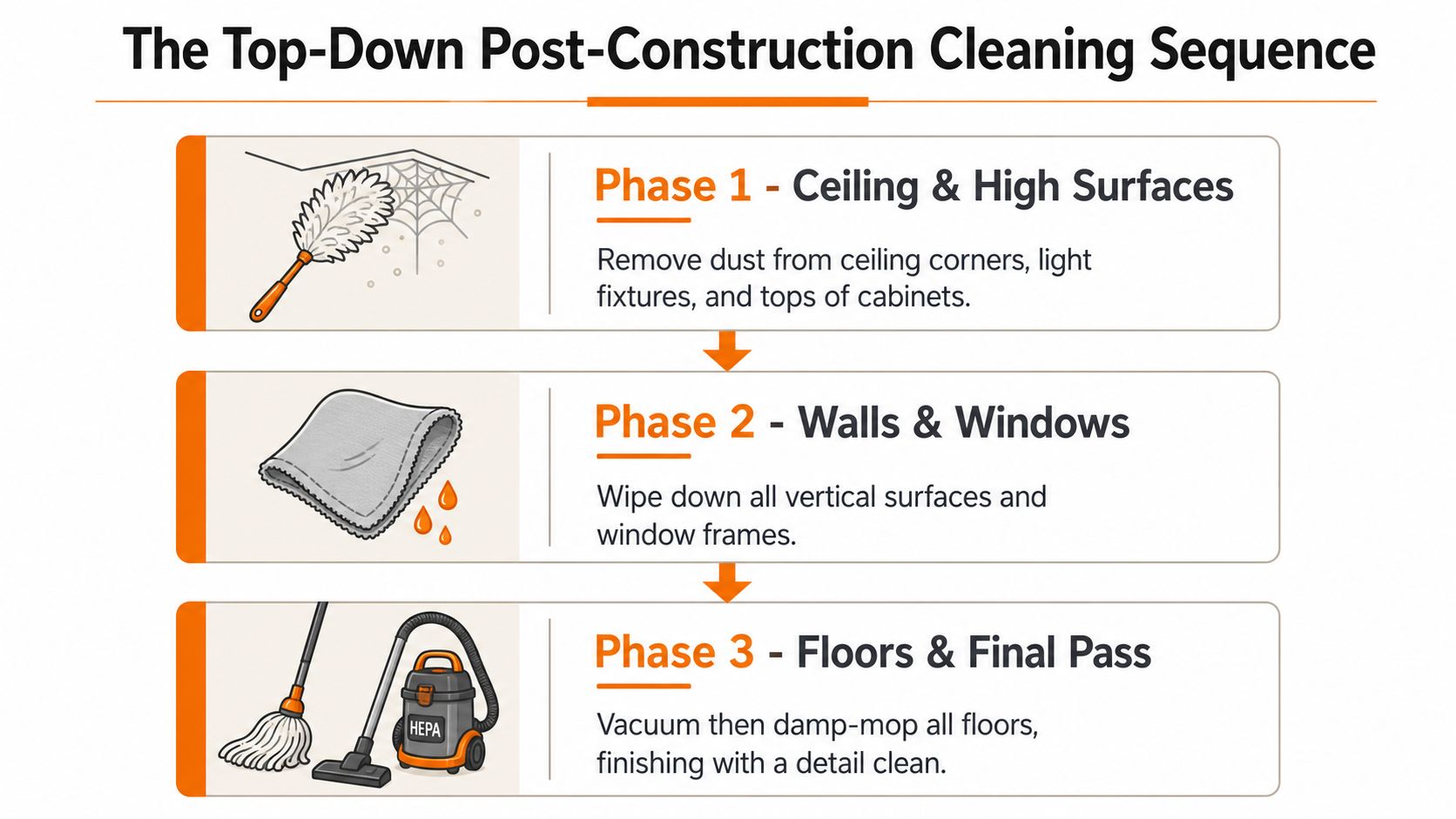
Work from ceiling to floor
Dust ceiling corners, fan blades, light fixtures, tops of cabinets, and vents first. Follow with walls, doors, window frames, tropical-pollen-covered sills, and tracks. On new bathrooms, grout haze and adhesive residue around glass shower enclosures often need surface-specific treatment, not forceful scrubbing.
Misting a small area before wiping helps keep settled dust from becoming airborne. Use damp microfiber on counters, sinks, cabinet exteriors, mirrors, and fixtures. Change cloths frequently, particularly in an Airbnb kitchen where sticky residue and construction dust can combine.
Finish with baseboards, toe kicks, and floors. Vacuum hard floors and carpet with the HEPA unit, then damp-mop suitable hard flooring. Wait for disturbed dust to settle, then make a second HEPA pass. That final vacuum catches particles released during wiping and mopping.
For additional guidance on debris removal and final touches, focus on the small details that affect a walkthrough. The following video also demonstrates the kind of methodical sequence that works better than rushing from room to room.
Managing HVAC Systems and Hidden Dust Zones
A clean living room won't stay clean if the return grille, filter housing, or nearby duct surfaces still hold renovation dust. In a West Palm Beach home, the AC may redistribute that material across bedroom doors, hallway trim, and furniture every time the system cycles.
Replace the HVAC filter after dusty work, following the system and filter manufacturer's requirements. Don't push a filter into a setup that can't handle it. If dust is visible inside ductwork, around returns, or behind multiple grilles, an HVAC professional should assess the system rather than having a cleaner reach blindly into ducts.
The zones most crews miss
- Window tracks: Fine dust mixes with tropical pollen and becomes a sticky line that a flat mop won't reach.
- Baseboard gaps: Drywall compound settles along the lower edge and reappears after vacuuming.
- Cabinet tops: Air currents deposit powder above upper cabinets and inside seldom-used storage.
- Vent covers: Dust collects behind grille fins and can fall back onto clean floors.
- Door tops: A quick eye-level wipe misses the ledge where circulating air leaves residue.
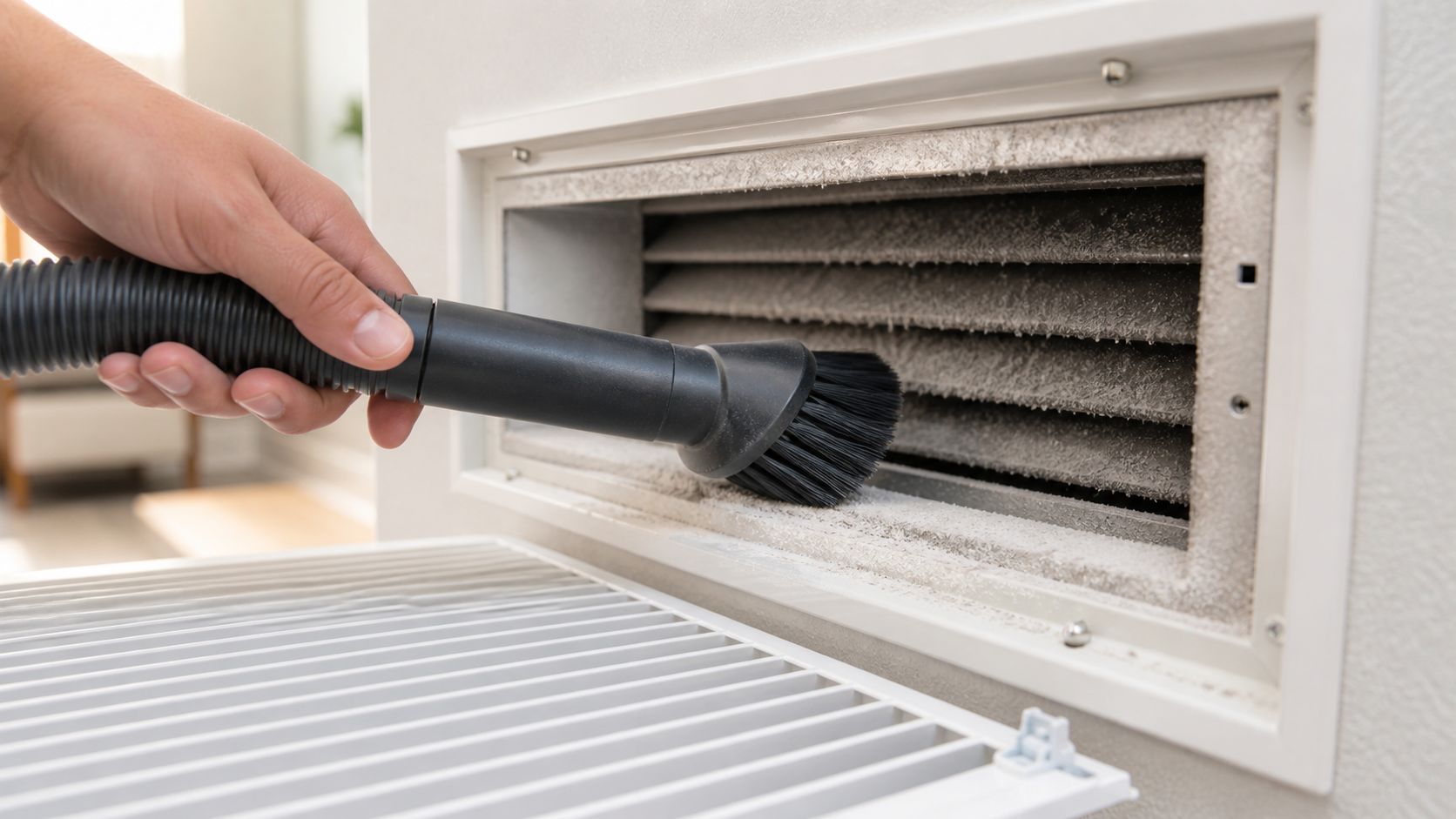
For occupied homes, keep the renovation zone isolated, use controlled filtration, and clean rooms in sequence. Finish floors only after high surfaces, vents, and vertical areas are done. Guidance recommends pairing HEPA vacuuming with damp mopping and microfiber or tack wiping because cleaning itself can increase airborne particles. Our guide to cleaning vents covers the visible grille and surrounding areas, but contaminated duct interiors require specialized evaluation.
When Construction Dust Becomes a Health Hazard
Not every powder on a countertop carries the same risk. Ordinary drywall dust is irritating and difficult to remove, while concrete and masonry work can generate respirable crystalline silica. OSHA sets silica's permissible exposure limit at 50 micrograms per cubic meter of air averaged over an 8-hour work shift. OSHA's construction information explains why source capture and filtration matter before dust spreads.
Older Palm Beach County homes require extra caution. For renovation work in homes built before 1978, EPA's RRP rule requires lead-safe practices, including training and certification for firms disturbing painted surfaces. EPA defines a dust-lead hazard at 40 µg/ft² on floors or 250 µg/ft² on interior window sills, based on wipe samples. See EPA's lead regulations before cleaning renovation dust in an older property.
Know when to stop
Suspected asbestos, lead contamination, heavy silica dust, visible duct contamination, or persistent coughing and eye irritation are reasons to pause DIY work. Don't dry sweep, use compressed air, or run an unsealed vacuum through the home.
EPA's clearance framework also lists 400 µg/ft² for window troughs and explains that required end-of-renovation sampling must be performed by a certified inspector, risk assessor, or dust sampling technician. EPA's clearance guidance makes the practical point clear: where testing applies, cleanup isn't complete until results meet the applicable action levels.
When to Hire Professional Post-Construction Cleaners
DIY cleanup can make sense for a contained, single-room refresh with minimal dust and no hazardous-material concerns. A whole-home renovation is different, especially when HVAC has circulated particles, the property has fresh finishes, or an Airbnb must be guest-ready inside a tight turnover window.
Sunset Shine Home Cleaning provides post-construction cleaning in Palm Beach County with room-by-room sequencing, fine drywall dust removal, grout haze treatment, adhesive residue work, HEPA vacuuming, damp wiping, and final detail checks. The same approach helps with move-out homes where landlords inspect kitchens, bathrooms, floors, baseboards, and window sills first.
For duct concerns, homeowners may also want to understand post renovation duct cleaning cost before choosing between surface cleaning and HVAC service. Review post-construction cleaning rates per hour when comparing estimates.
Sunset Shine serves West Palm Beach, Palm Beach Gardens, Jupiter, Juno Beach, North Palm Beach, Riviera Beach, Royal Palm Beach, Lake Worth, Boynton Beach, Delray Beach, Boca Raton, Wellington, Westlake, Loxahatchee, Loxahatchee Groves, and The Acreage. Most clients request a custom estimate based on bedrooms, bathrooms, square footage, condition, and add-ons.
What the service can include
- Post-construction reset: Dust removal, floors, baseboards, vents, grout haze, and residue.
- Move-in or move-out clean: Deep cleaning plus inside the oven, refrigerator, and cabinets.
- Airbnb turnover: Bathrooms, kitchens, floors, high-touch surfaces, and same-day readiness.
- Property management support: Consistent checklists, make-ready cleans, and maintenance issue flagging.
Book Sunset Shine Home Cleaning for a post-construction clean that tackles fine dust, vents, grout, baseboards, and the hidden areas that keep redepositing particles. Call 561-408-4020 or visit the website to arrange service across West Palm Beach and Palm Beach County.