
An HOA common area can look clean at the monthly meeting and still be one storm, leak, or tenant complaint away from trouble. In Palm Beach County, humidity, salt air, beach sand, tropical pollen, and hurricane-season debris turn shared-property upkeep into a daily operations issue, not a box to check.
This guide is for HOA boards, property managers, condo associations, homeowners, renters, and vendors who need common spaces to stay safe, presentable, and within budget. It focuses on the hands-on work behind HOA common area maintenance, including cleaning, landscaping, inspections, vendor contracts, and reserve decisions.
Table of Contents
- What HOA Common Area Maintenance Actually Covers
- Who Is Responsible Under Florida Law and Your Governing Documents
- The Seasonal and Task-Based Maintenance Checklist
- Budgeting, Reserve Funds, and the Gray Zone Between Them
- A Palm Beach County Maintenance Scenario Worth Learning From
- Choosing and Contracting the Right Vendors
- Inspections, Documentation, and Reserve Planning
- Why Cheap HOA Fees Often Mean Expensive Common Area Maintenance
What HOA Common Area Maintenance Actually Covers
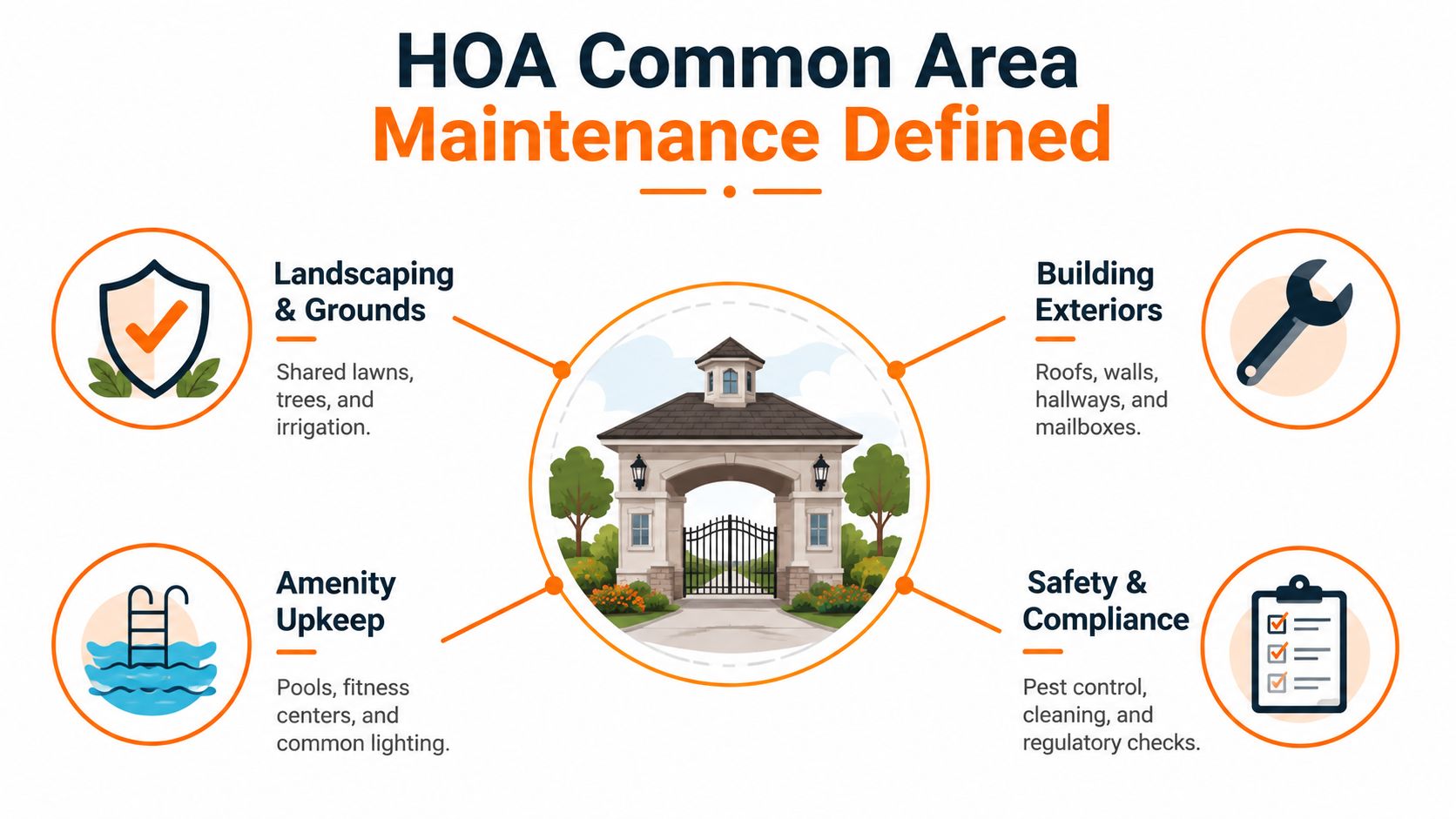
HOA common area maintenance means keeping shared property functional, clean, safe, and presentable when the association, rather than an individual owner, is responsible for it. That usually includes lobbies, hallways, elevators, pool decks, fitness rooms, parking lots, walkways, lighting, landscaping, shared restrooms, mail areas, and building exteriors.
The easiest way to define responsibility is to inventory every shared asset. Then ask two questions: does the association operate it routinely, and is the work a recurring service or a long-life replacement?
Operating work versus replacement work
Operating expenses cover repeating tasks such as janitorial service, pool care, irrigation checks, lighting electricity, pest control, landscaping, and minor repairs. Reserve items generally cover major replacements, including roofs, paving, elevators, and other long-life components. The governing documents and reserve plan should determine the final classification.
Palm Beach County adds its own complications. Salt air corrodes outdoor fixtures, humidity encourages mildew in covered walkways and stairwells, and sand from coastal properties migrates into pool decks, corridors, and elevator entries. A vendor scope that says “clean common areas” isn't specific enough. It should name the surfaces, frequency, equipment, reporting method, and response standard.
For a useful grounds-management comparison, boards can review this Prestonwood Commercial Landscape Services guide, then adapt the principles to South Florida irrigation, palms, tropical growth, and heavy rain.
Who Is Responsible Under Florida Law and Your Governing Documents
Florida HOAs generally look first to the declaration, bylaws, and CC&Rs, then to Chapter 720. The practical rule is straightforward: the association maintains common areas unless the governing documents assign a specific duty elsewhere. Owners remain responsible for private areas unless those documents create a different obligation.
A responsibility matrix prevents arguments from becoming maintenance policy.
| Asset | Usual association duty | What to verify |
|---|---|---|
| Landscaping | Shared lawns, trees, shrubs, and irrigation | Declaration and landscape provisions |
| Roofs | Inspection, repair, and replacement where assigned | Building type and CC&Rs |
| Building exteriors | Walls, paint, shared doors, and visible finishes | Maintenance definitions |
| Lighting | Common walkways, parking, entrances, and amenities | Electrical and access responsibilities |
| Amenities | Pool areas, fitness rooms, clubhouses, and restrooms | Association-installed improvements |
A representative association policy assigns the HOA responsibility for common-area landscaping, roofs, building exteriors, and association-installed shrubs and trees. Owners can't independently alter those plantings without board consent. In California, the default rule similarly places common-area maintenance with the association unless the declaration says otherwise, and boards must inspect common areas at least once every three years and prepare a reserve study, as summarized in the provided association responsibilities policy.
Why the word “shall” matters
Florida disputes often turn on exact wording. If a declaration says the association “shall maintain” an item, the duty is mandatory, not an optional improvement project. Chapter 720 compliance can be pursued through legal action when an association fails or refuses to follow the statute or governing documents, according to this explanation of Florida HOA common-area legal options.
The same document-review discipline applies to pest responsibilities. Boards dealing with infestations should separate shared-property duties from owner obligations and review practical guidance on bed bug rules for Florida landlords.
The Seasonal and Task-Based Maintenance Checklist
Palm Beach County doesn't offer a neat four-season maintenance calendar. Rain, heat, salt exposure, and hurricane preparation create a better system: schedule work by risk and frequency.
High-frequency checks
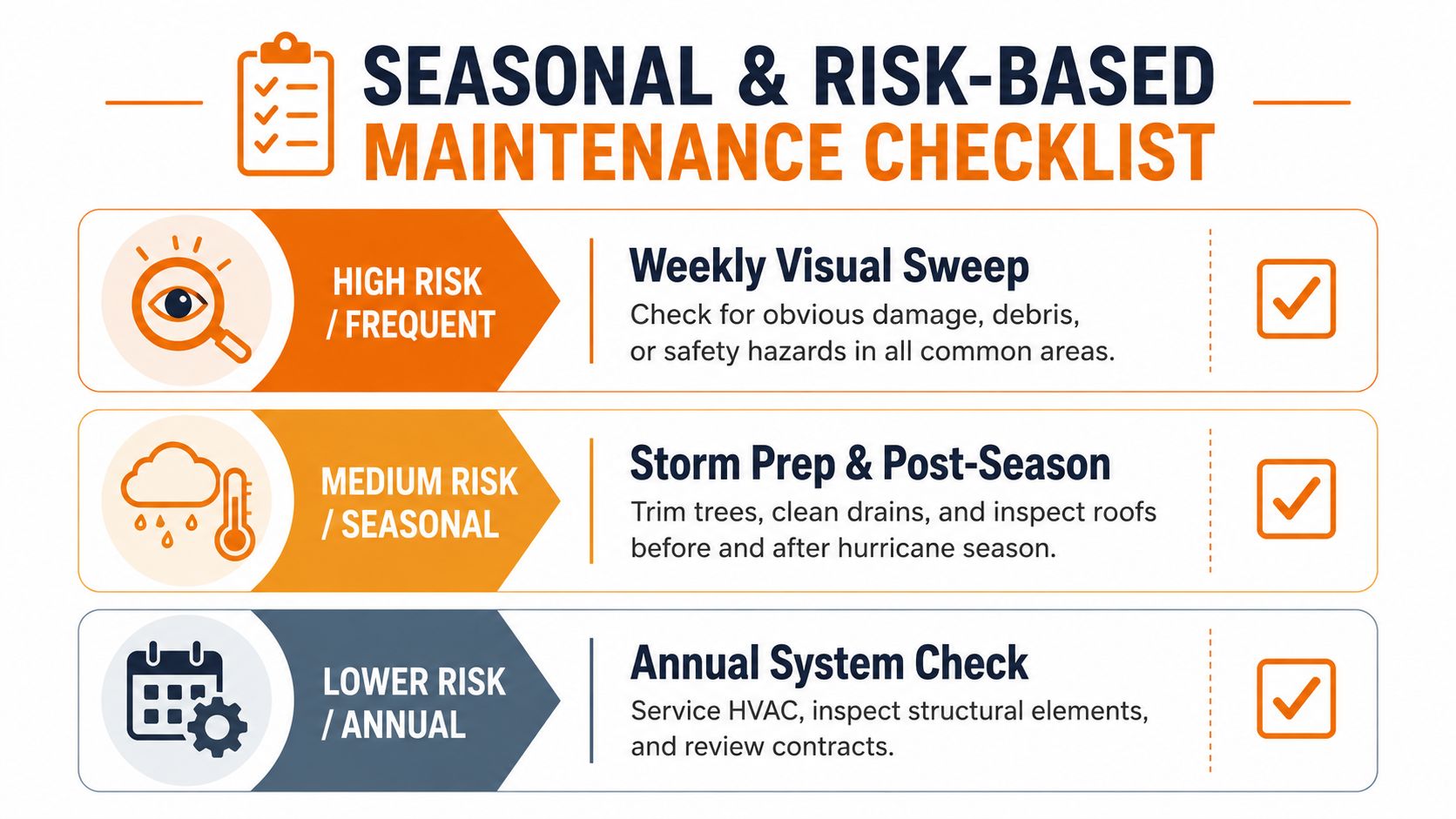
A weekly visual sweep should cover roofs and other leak-prone assets, walkways, stairwells, pool decks, parking surfaces, lighting, drains, gates, and visible landscaping damage. Staff should look for standing water, loose pavers, cracked pavement, mildew, fallen branches, burned-out fixtures, and debris near storm drains.
Monthly spot checks should focus on high-use amenities, including pools, playgrounds, fitness equipment, parking lots, shared restrooms, and trash enclosures. Teams catch palmetto bugs near dumpsters, mildew on shaded stairs, sand packed into deck edges, and grime on elevator buttons before residents escalate the complaint.
Contractor and storm checks
Quarterly contractor inspections should cover irrigation, lighting, elevators, fire-life-safety systems, pool equipment, roofs, and drainage. Before and after hurricane season, vendors should trim vulnerable trees, clear drains, inspect roof edges, secure loose items, and document storm-related damage.
Expert guidance commonly recommends weekly visual checks, monthly spot checks, quarterly contractor inspections, and a full professional walk-through at least every three years. Those tiers are summarized in HOA Leader's maintenance guidance.
Use this landscaping management guide for facilities when building an RFP, especially for irrigation, tree care, and seasonal grounds work. Pool teams should also understand how pool vacuum systems work so cleaning scopes distinguish surface debris from equipment maintenance.
Budgeting, Reserve Funds, and the Gray Zone Between Them
The operating budget should pay for recurring work: landscaping, janitorial cleaning, pool service, pest control, lighting electricity, irrigation service, and small repairs. Reserve funds should support major capital work such as roofs, paving, elevators, and other long-life replacements.
The difficult decisions happen between those categories. Replacing a broken light is routine. Replacing an entire lighting system is capital work. Repeatedly patching a failing walkway may be an operating expense on paper, but it can signal that the board needs an updated reserve study instead of another temporary repair.
Practical rule: When the same defect keeps returning, stop treating each invoice as an isolated repair. Ask whether the asset itself is approaching replacement.
HOA fees show why boards must define scope carefully. The national average monthly HOA or condo fee reached $243 in 2023, compared with $191 in 2021 and $170 in 2019, according to this HOA common-area maintenance overview. The U.S. Census Bureau's 2023 American Housing Survey reports Florida's average at $240.10, while Miami averages $383 per month in the Census-based comparison published by Zillow.
Those dues also support trash removal, lawn care, repairs, and other shared services. A board should be able to show owners what frequency buys, what reserves cover, and which deferred items could create a special assessment.
Florida HOA reserve treatment isn't identical for every association. Under Chapter 720, accounts are treated as statutory reserves when owners vote to provide for them, while properly established reserves are generally intended for capital expenditures and deferred maintenance. Florida condominium law is more specific, requiring budgets to include reserves for roofs, building painting, pavement resurfacing, and other items exceeding $25,000 or the inflation-adjusted amount determined by the division, based on remaining useful life and current replacement cost, as stated in Chapter 718.
A Palm Beach County Maintenance Scenario Worth Learning From
A mid-sized HOA near West Palm Beach had a routine walkway sweep reveal an unusual ridge of sand along a perimeter wall. The sand looked like ordinary beach debris, but it was pressing against hairline cracks near an irrigation main.
During the monthly spot check, the landscaping contractor noticed pressure loss and traced it to a damaged line. The board authorized a $2,800 line repair instead of facing a $40,000 paving and regrading project after a leak undermined the sidewalk.
The physical inspection worked. The documentation did not. The previous property manager had no dated photos, so the insurance claim stalled while the board tried to reconstruct when the damage appeared and who had reported it.
That scenario captures the essential value of HOA common area maintenance. Sweeping, pressure checks, drain clearing, and photo logs seem routine until they prevent water from reaching pavement, walls, or electrical equipment.
Boring maintenance is often the strongest reserve strategy a community has.
Boards should require vendors to photograph recurring trouble spots, record the condition observed, identify the person who found it, and attach the repair invoice to the same work order. In coastal communities, sand and salt can conceal problems quickly, so visual cleanliness and asset inspection need to happen together.
Choosing and Contracting the Right Vendors
Boards buy three broad vendor categories: common-area cleaning, landscaping and irrigation, and specialty trades such as pool service and lighting. Each needs a different scope, but the selection process should remain disciplined.
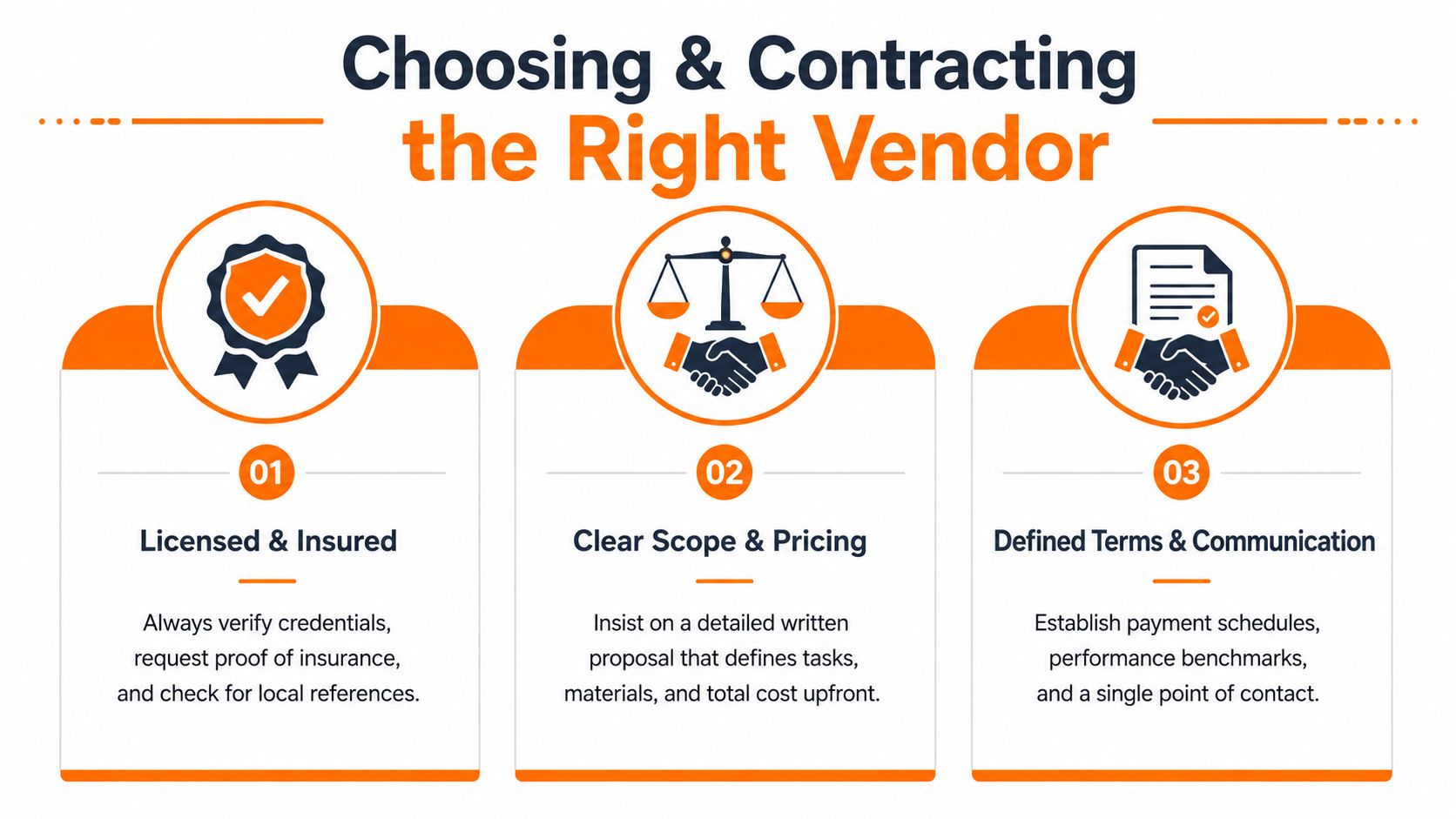
Request at least three bids and verify licenses, insurance, references, and service history. Ask for references from at least two Palm Beach County properties of similar size, not only a residential customer who hired the company once.
Put the standard in writing
A cleaning contract should identify lobbies, elevators, restrooms, pool facilities, floors, glass, high-touch surfaces, trash areas, and supply responsibilities. A landscaping contract should specify mowing, pruning, irrigation inspections, storm preparation, debris removal, and reporting.
Require measurable frequency, photo-based quality reports, emergency response terms for hurricane damage or board-up calls, a single point of contact, payment conditions, and a termination clause. “As needed” is not a scope. It shifts control to the vendor and makes poor performance difficult to prove.
Property managers earn their markup when a community has multiple buildings, frequent vendor failures, or no volunteer with time to inspect work. A capable board member can supervise a smaller property, but only with written checklists and consistent records.
For post-construction projects, fine drywall dust, grout haze, adhesive residue, and debris require a separate scope. A construction debris removal service can be evaluated alongside the final cleaning vendor instead of leaving cleanup responsibilities unclear.
Inspections, Documentation, and Reserve Planning
A board changes. A property manager changes. Documentation is what survives both. Every walk-through should produce a dated record that shows the asset, condition, location, recommended action, and responsible vendor.
Photograph roof edges, drains, pool equipment, pavement cracks, lighting failures, irrigation leaks, mildew-prone stairwells, and damaged landscaping. Use consistent angles, condition scores, timestamps, and location notes. Before-and-after images make recurring work easier to verify and give the next treasurer a usable history.
Build one maintenance record
Use a shared folder organized by asset, not by vendor. Store monthly photo logs, quarterly contractor reports, proposals, invoices, inspection findings, board approvals, and completed repairs together.
Florida guidance supports a full professional common-area walk-through at least every three years for condition assessment and reserve planning. Florida condominium law requires reserve calculations for covered items based on remaining useful life and current replacement cost, including the statutory threshold described earlier.
A practical rhythm looks like this:
- Monthly: Add inspection photos and open work orders.
- Quarterly: File contractor reports and confirm unresolved defects.
- Every three years: Update the professional condition and reserve review.
Good records also protect owners and boards when a maintenance dispute escalates. For active leaks or moisture intrusion, preserve photos before cleanup and coordinate appropriate water damage cleanup service work without destroying evidence of the original condition.
Why Cheap HOA Fees Often Mean Expensive Common Area Maintenance
Low dues don't automatically mean efficient management. They may mean the board is postponing cleaning, inspections, repairs, or reserve contributions that residents will eventually pay for through backlogs and assessments.
Underfunded reserves can make common-area upkeep appear affordable for a short period. Then a roof, elevator, paving system, or major building component reaches the end of its useful life, and the community faces a funding decision that routine dues can't absorb.
For buyers and current owners, the dues line is only the beginning. Request and review:
- The reserve study: Look for aging roofs, paving, elevators, drainage, and other major components.
- Recent inspection reports: Compare identified defects with completed work orders.
- Vendor contracts: Check whether the scope matches the property's actual cleaning, landscaping, and storm needs.
- Board minutes: Look for repeated complaints, postponed repairs, and unresolved safety issues.
Florida reserve treatment depends on whether owners have voted statutory reserves into existence under Chapter 720 and what the governing documents require. That makes document review essential before assuming low dues reflect a healthy community.
Palm Beach County boards should budget for the climate they manage. Salt exposure, high humidity, tropical growth, sand, and hurricane preparation aren't optional extras. They belong in the operating plan, the inspection schedule, and the vendor contract.
Sunset Shine Home Cleaning provides recurring common-area cleaning, deep cleaning, move-in and move-out service, post-construction cleanup, and Airbnb turnover support across West Palm Beach and Palm Beach County. For clean lobbies, amenity spaces, restrooms, floors, baseboards, and high-touch surfaces that hold up between inspections, visit Sunset Shine Home Cleaning, or call 561-408-4020 to request a service estimate.