
You've wiped the counters, swept the sand, and still notice fingerprints on the refrigerator handle, a dull film on the faucet, or buildup around the bathroom light switch. In Palm Beach County homes, high touch surface cleaning matters because humidity, salt air, beach sand, AC dust, and busy guest turnover put fresh grime back on the places hands use most.
For homeowners, renters, Airbnb hosts, and property managers, the goal is practical: a spotless home, a deposit-ready apartment, a guest-ready rental, or a move-in-ready space without missing the small contact points a landlord or guest notices first.
Table of Contents
- Why High Touch Surfaces Need Special Attention at Home
- How to Identify and Prioritize High Touch Surfaces in Every Room
- Proper Technique for Cleaning and Disinfecting High Touch Points
- Room by Room Cleaning Schedules and Printable Checklist
- Choosing Non Toxic Products and Avoiding Common Mistakes
- When to Handle It Yourself and When to Book Professional Cleaning
Why High Touch Surfaces Need Special Attention at Home
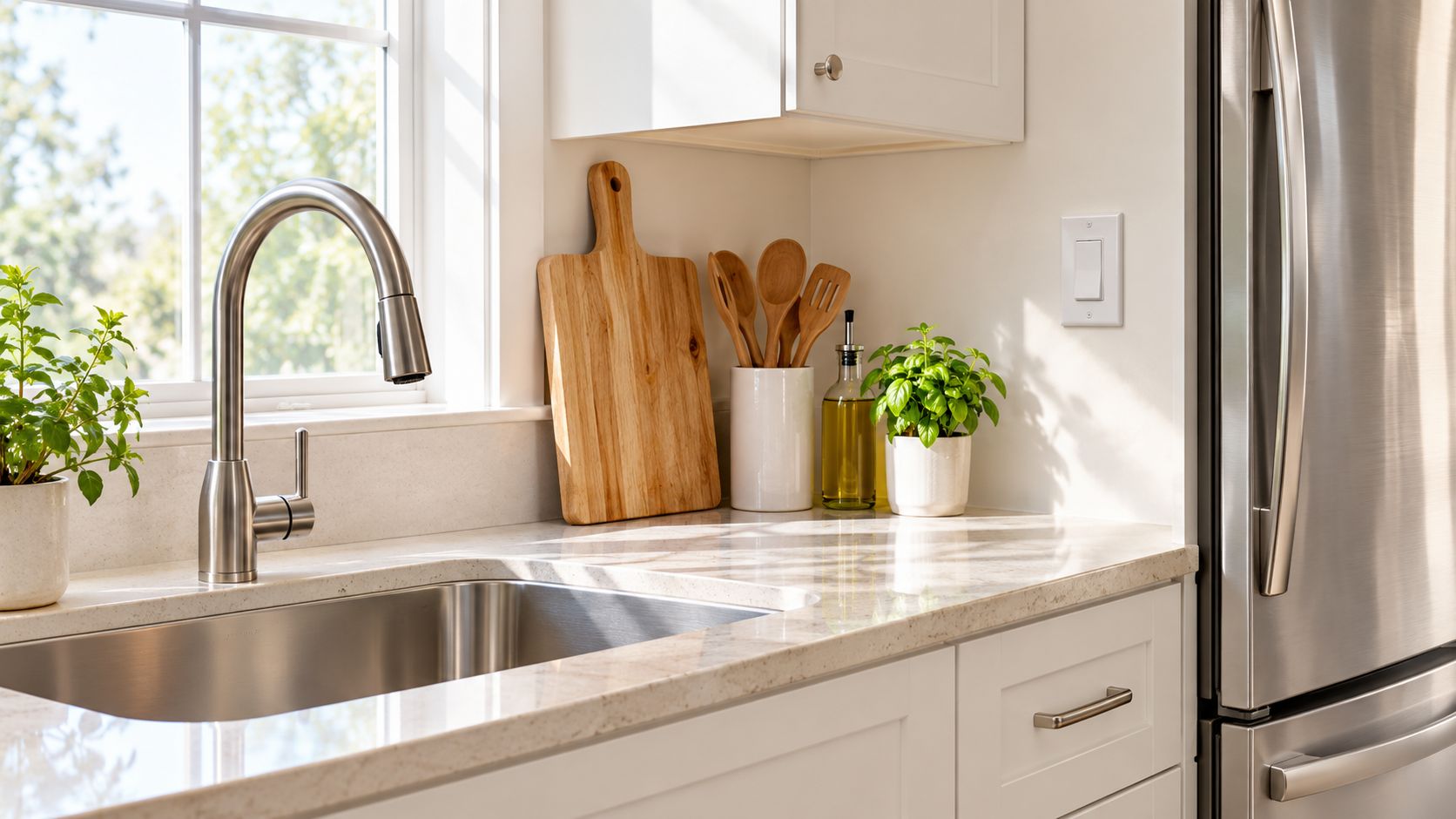
A clean kitchen can still have a greasy refrigerator pull. A freshly mopped hallway can still have a sandy doorknob. In a West Palm Beach home, several people may touch the same faucet, light switch, cabinet pull, and remote while humidity keeps bathroom surfaces damp and AC dust settles nearby.
Touched objects can become recontaminated quickly after cleaning. CDC guidance identifies bedrails, IV poles, sink handles, bedside tables, medication-prep counters, privacy-curtain edges, monitoring equipment, wheelchair handles, call bells, and doorknobs as high-touch examples across healthcare and public environments, but the same principle applies at home. A CDC cleaning overview notes that routine cleaning and targeted attention serve different purposes.
A 2021 review concluded that daily whole-room cleaning alone provides limited reduction in MRSA transmission unless frequent targeted cleaning is added. When wiping happens 3 times per hour or less, the review recommends prioritizing high-touch points. When wiping happens more often than 3 times per hour, cleaning should extend to low-touch surfaces according to touch frequency, as detailed in the CDC-linked review.
That's why a useful routine identifies, prioritizes, cleans, and checks contact points instead of treating every surface alike. Families, renters, and Airbnb hosts get better results by focusing effort on the handles and switches that hands keep returning to.
You'll also find that dust, mites, and insects can collect in overlooked areas, especially where AC systems run constantly. Sunset Shine's guidance on dust mites and bed bugs can help with that broader household concern.
How to Identify and Prioritize High Touch Surfaces in Every Room
Start with a simple hand-tracing test. Walk through the home and note every surface touched when someone enters, cooks, showers, watches television, or leaves for work. Mark shared points first, then add surfaces exposed to food grease, bathroom moisture, pet contact, or beach sand.
Build the list room by room
In the kitchen, begin with the refrigerator handle, faucet lever, sprayer button, stove knobs, microwave keypad, trash-can lid, cabinet pulls, and counter edges. Palm Beach kitchens often collect a sticky mixture of cooking oil, sunscreen, and fine sand around handles after a beach day.
Bathrooms need a different priority. Put the faucet handles, toilet flush lever or button, sink edge, shower control, light switch, doorknob, and cabinet pulls at the top. High humidity makes soap residue cling to fixtures, while grout lines and the area behind the toilet can stay damp longer than the rest of the room.
Entryways deserve attention in coastal and rainy-season homes. Include the front doorknob, deadbolt, garage keypad, light switches, stair rail, and nearby console handles. During rainy weather, muddy hands transfer residue to knobs even when the tile floor has already been cleaned.
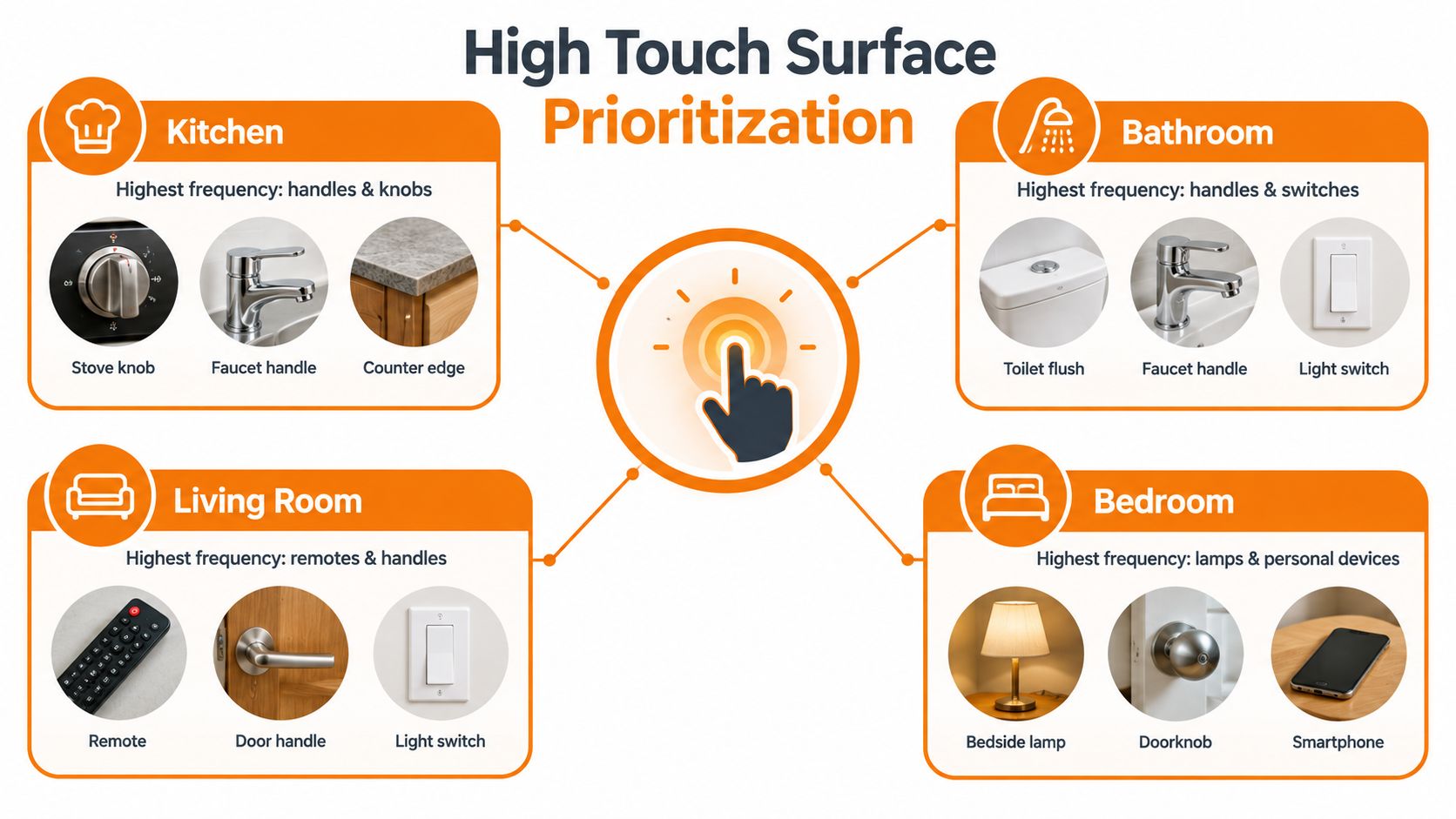
Living rooms and bedrooms usually center on remotes, lamp switches, phones, device screens, drawer pulls, and doors. Year-round AC use adds dust to vents and window sills, but those aren't automatically high-touch. Clean them on a broader schedule while handling the frequently touched controls more often.
For a move-out or apartment reset, use this apartment deep cleaning checklist to catch contact points alongside floors, cabinets, and bathroom fixtures.
Proper Technique for Cleaning and Disinfecting High Touch Points
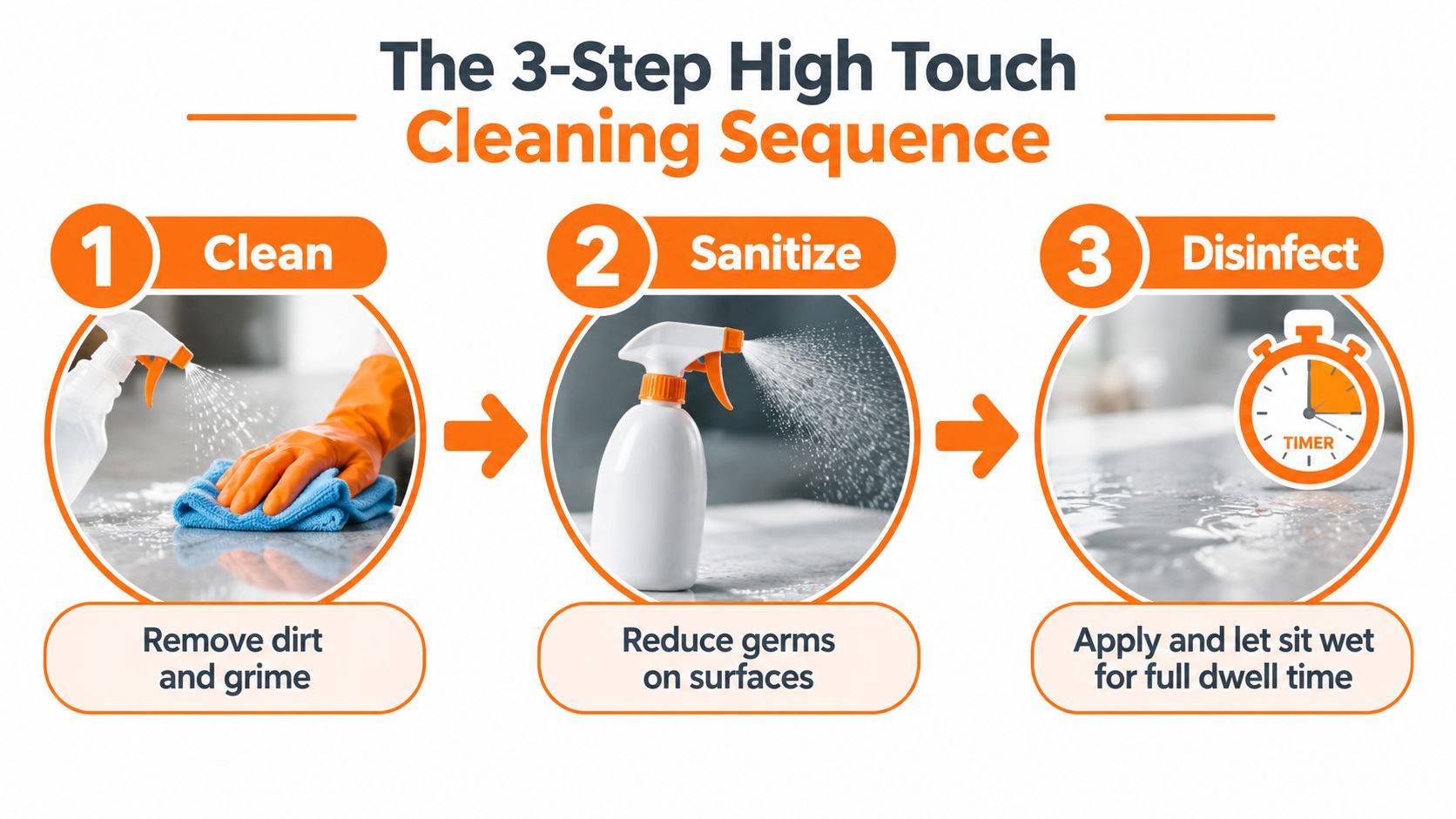
A quick swipe can remove a fingerprint without removing much residue. The reliable sequence is clean first, then sanitize or disinfect when the situation calls for it.
Cleaning removes dirt and grease. Sanitizing reduces germs on a surface, while disinfecting uses a labeled product intended to kill germs. After visible illness, contamination, or a guest turnover, disinfection may be appropriate. For ordinary daily maintenance, regular cleaning may be enough for some surfaces, as CDC home guidance explains in its cleaning and disinfecting recommendations.
Use friction before chemistry
Use a clean microfiber cloth with a material-safe cleaner. Fold the cloth so you can turn to a fresh side, and work around edges, seams, button borders, and the underside of handles. On a greasy stove knob or refrigerator pull, a mild degreasing step comes before disinfectant.
Pre-impregnated wipes can be practical during a tight Airbnb turnover. Research summarized in a clinical study found that this approach outperformed a standard cleaning protocol on heavily contaminated high-touch surfaces, with residual disinfection activity lasting up to 6.5 hours, according to the published study. That doesn't make every wipe suitable for every finish, so read the label and match the product to the surface.
Respect dwell time
Disinfectant only works as directed when the surface stays visibly wet for the full label contact time. One EPA-registered label specifies 3 minutes of visibly wet contact, while EPA List Q includes products requiring 5 minutes on some hard, nonporous surfaces. Contact time varies, so use the product label or Safety Data Sheet, not a guess, as shown in this EPA disinfectant label.
Never spray directly onto a phone, remote, switch opening, keyboard, or other electronic seam. Apply product to a cloth when the label allows it, keep liquid controlled, and use a separate cloth for each room. For detailed switch technique, see how to clean light switches.
Room by Room Cleaning Schedules and Printable Checklist
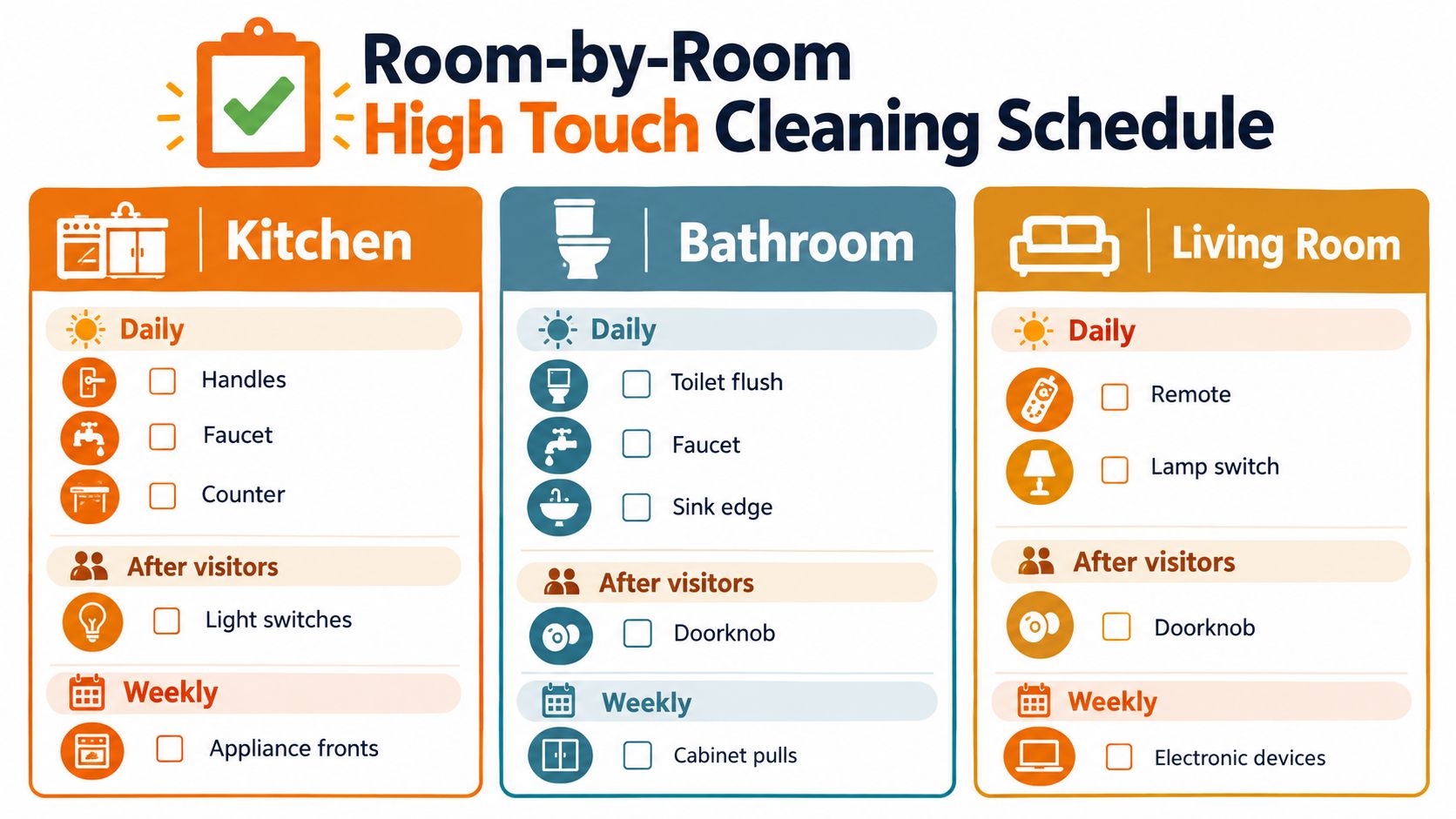
A workable schedule responds to use, not anxiety. CDC home guidance specifically recommends regular cleaning of high-touch surfaces such as light switches, doorknobs, and countertops, including after visitors. In a South Florida home, add local triggers such as rainy-season mud, tropical pollen on window sills, and bathroom moisture after showers.
Daily or routine touchpoint list
- Kitchen: Wipe the refrigerator handle, faucet, counter edge, stove knobs, and microwave controls.
- Bathroom: Clean the flush lever, faucet handles, sink edge, light switch, and doorknob.
- Living room: Wipe the remote, lamp switch, shared table edge, and frequently handled device controls.
- Entryway: Check the front knob, garage keypad, light switches, and stair rail when sand or mud is present.
After visitors or illness
Give extra attention to shared switches, doorknobs, remotes, bathroom fixtures, and guest-room surfaces after visitors. If someone has been ill, clean visible soil first, then use a suitable disinfectant according to its label.
Weekly detail work
Clean cabinet pulls, appliance fronts, less-used handles, window sills, vents, and fan controls. In vacation rentals, combine this with the checkout checklist so the next guest doesn't encounter sticky kitchen residue or fingerprints on balcony doors.
A practical printable version is simple:
- Kitchen: handles, faucet, counter, knobs, keypad
- Bathroom: flush control, faucet, sink edge, switch, knob
- Entry: door hardware, switches, keypad, rail
- Living areas: remote, lamp switch, devices, shared tables
- Weekly additions: cabinet exteriors, vents, sills, appliance fronts
Choosing Non Toxic Products and Avoiding Common Mistakes
Eco-friendly daily cleaning and disinfecting aren't interchangeable. A non-toxic cleaner can be the right choice for dust, fingerprints, light residue, and routine maintenance, especially in homes with children, pets, or sensitive occupants. After obvious illness or contamination, a properly labeled disinfectant may be the more suitable option.
The product must match the material. Salt air can dull or spot coastal metal fixtures, wood can react poorly to excess moisture, and electronics need controlled application. A reusable microfiber workflow offers friction and less waste, but it only works when cloths are changed between rooms and laundered correctly.
Pre-impregnated wipes are faster for a property manager working through a tight turnover, but they still need enough product coverage and dwell time. A quick wipe that dries immediately may look finished without meeting the label's disinfection requirement.
Practical rule: If the surface is dirty, clean it first. If you're disinfecting, keep it wet for the entire labeled contact time.
Common failures include:
- One cloth everywhere: This moves kitchen grease into bathroom areas.
- Edges ignored: Handles, switch plates, control panels, and remote seams hold what broad wiping misses.
- Spray and immediate wipe: Removing the product early cuts short its intended contact time.
- Product mixing: Never combine cleaners or disinfectants unless the label specifically permits it.
- Overusing disinfectant: Routine cleaning is often enough unless illness, visible contamination, or a high-turnover situation changes the need.
Sunset Shine Home Cleaning uses non-toxic, eco-friendly products for routine residential service and adjusts the approach to the home, occupants, and requested add-ons.
When to Handle It Yourself and When to Book Professional Cleaning
DIY maintenance works when the home is already under control and you can consistently reach the hidden contact points. Book help when humidity has left persistent mold in grout, a post-hurricane cleanup has spread residue, construction dust remains in corners, or a landlord walkthrough is approaching.
Professional service is also practical for move-in and move-out cleans, occupied homes with heavy pet hair, and Airbnb turnovers with tight checkout windows. A detailed visit can combine bathrooms, kitchen degreasing, floors, baseboards, cabinet exteriors, mirrors, window sills, vents, and targeted high-touch disinfection.
For quality verification, healthcare teams have used fluorescent markers on selected touchpoints, followed by UV inspection. One study defined compliance as properly cleaning at least 8 of 10 monitored surfaces, creating a measurable audit instead of relying only on appearance, as described in this UV verification study.
If you manage several rentals or need help coordinating recurring work, virtual assistant services by CS Outsource can support administrative tasks while cleaners focus on the property.
Sunset Shine follows Schedule, Clean, Inspect, Enjoy. You can book recurring standard cleaning, deep cleaning, move-in or move-out service, post-construction cleanup, Airbnb turnover, or property-management maintenance across West Palm Beach, Palm Beach Gardens, Jupiter, Juno Beach, North Palm Beach, Riviera Beach, Royal Palm Beach, Lake Worth, Boynton Beach, Delray Beach, Boca Raton, Wellington, Westlake, Loxahatchee, Loxahatchee Groves, and The Acreage.
Book your house cleaning service in West Palm Beach with Sunset Shine Home Cleaning for careful high touch surface cleaning, humidity-prone bathrooms, sandy entryways, and guest-ready turnovers. Call 561-408-4020 or visit Sunset Shine Home Cleaning to request your estimate and schedule a cleaner home.