
You spray the carpet before breakfast, the room smells clean for a little while, and by lunch the pet odor is back. In Palm Beach County, that usually means the product covered the smell instead of reaching the contaminated fibers, backing, or padding. A pet friendly carpet deodorizer can help, but only when the formula and application match the accident.
This guide is for homeowners, renters, Airbnb hosts, and property managers who need a spotless room, guest-ready rental, deposit-ready apartment, or move-in ready home. South Florida humidity, year-round AC, beach sand, tropical pollen, and rainy-season moisture make pet odors harder to manage than they look.
Table of Contents
- Why Pet Odors Linger in South Florida Carpets
- Enzyme Cleaners vs Odor-Masking Sprays
- Ingredients That Are Actually Safe for Pets
- How to Apply Carpet Deodorizer the Right Way
- DIY Recipes That Actually Work in Palm Beach Homes
- How Often to Deodorize Based on Your Household
- When to Call a Professional Carpet Cleaner
Why Pet Odors Linger in South Florida Carpets
A condo owner in West Palm Beach may clean a cat accident from the visible carpet and still notice ammonia later that day. In Boca Raton and Jupiter, windows often stay closed while AC runs year-round. Moisture and stale indoor air give odor compounds more opportunity to remain in fibers instead of disappearing.
Sand tracked in from beach homes adds another problem. It works into carpet like fine grit, carrying residue deeper and creating small pockets where smells remain. Padding acts like a sponge, especially after repeated accidents or an older contamination that has already traveled below the surface.
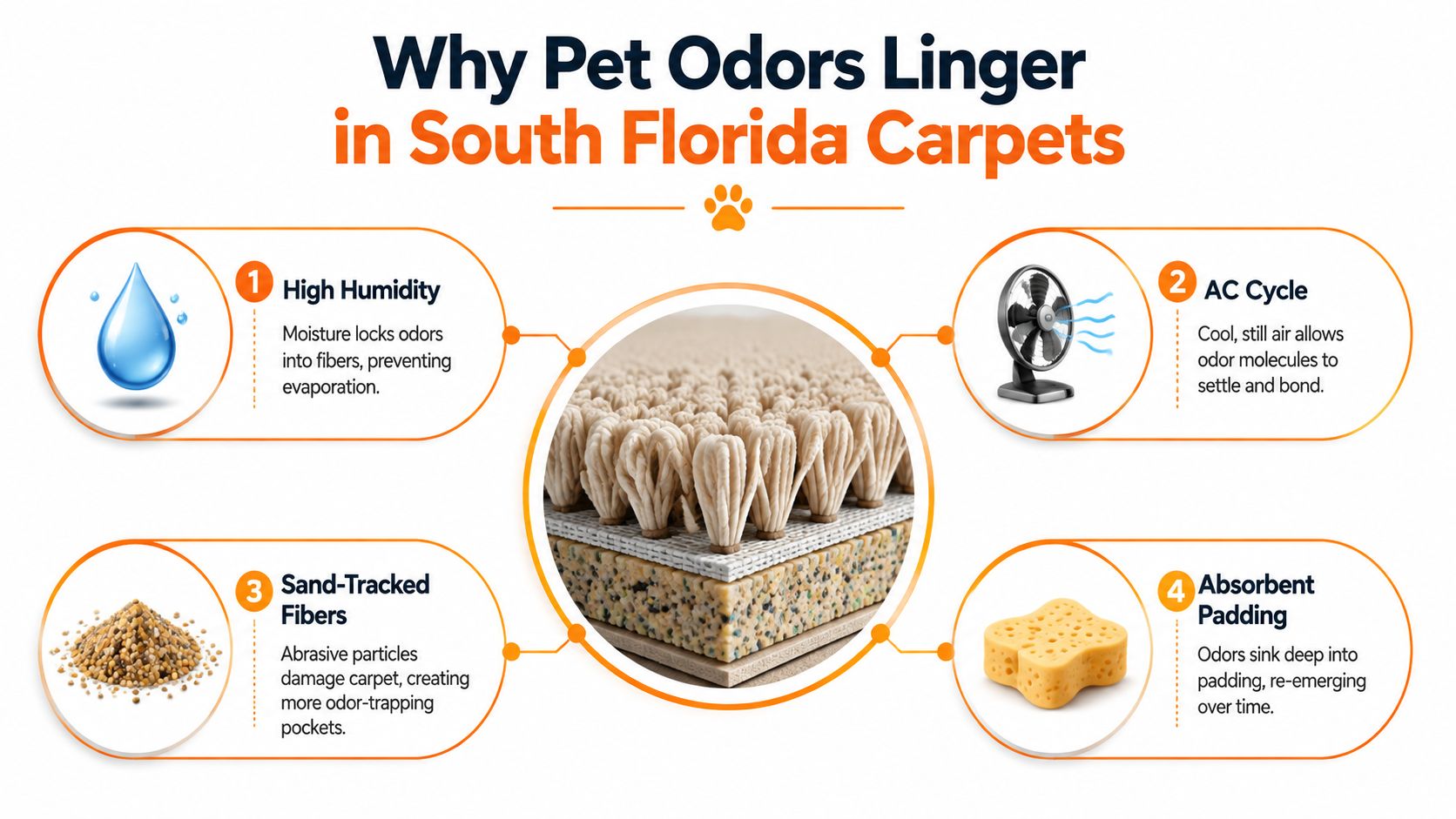
The local conditions that bring odors back
Humidity slows drying. Closed AC cycles keep the room cool but don't necessarily remove the odor source. Carpet age, padding condition, and the pet's habit of returning to one location all matter.
A controlled evaluation published in 2023 found that an odor-neutralizing product significantly outperformed a control and a commercial benchmark against cat urine odors, with results depending on both the formulation and the age of the contamination. The study was updated in 2025, keeping the finding relevant to product-efficacy discussions. See the carpet odor-control evaluation.
Field note: If the smell returns after the room warms up or the AC cycles off, assume the source is still present until testing proves otherwise.
For vomit, urine, or feces, the same layered approach applies. A surface deodorizer may be enough for a light, fresh smell, but removing vomit smell from carpet requires attention to residue, moisture, and drying.
Enzyme Cleaners vs Odor-Masking Sprays
The shelf usually offers two very different solutions. Enzyme cleaners break down organic residue, while odor-masking sprays add fragrance that competes with the smell in the air.
A PubMed-indexed comparison of 11 products found that newer products marketed for urine odor performed best at removing cat urine odor from carpet and preventing its return. The historical carpet odor study also compared newer and older urine spots, reinforcing a practical point: fresh accidents are easier to treat before residue reaches carpet backing and padding.
Choose by the source, not the fragrance
Use this decision check:
- Fresh urine, vomit, or feces: Choose an enzymatic formula and apply it to the actual contaminated area.
- Old urine odor: Use a product designed for biological odor, expect repeat treatment, and inspect the padding if the smell persists.
- General dog odor on surface fibers: Vacuum first, then consider a light deodorizer if there isn't a visible accident.
- A room that smells better only while wet: Stop buying stronger fragrance. The source hasn't been removed.
Look for protease on an enzyme cleaner label. Proteases target protein-based pet soils, and the product needs contact time to work. A purpose-built enzyme cleaner for odors is a more sensible category to compare than a perfume-heavy carpet freshener.
Benchmark testing reported a standardized enzyme spray reduced residual volatile compounds by 92%, while a foam aerosol reduced them by 68% after one application on a controlled carpet-pad urine test. The same review reported 93% detectable ammonia removal from a fresh sample and 73% from aged, crystallized contamination, showing why old Palm Beach condo odors can require more than one pass. Review the product-testing framework.
Ingredients That Are Actually Safe for Pets
“Natural” doesn't automatically mean safe for every animal. A cat, Labrador, and parrot sharing a home may react very differently to fragrance, vapors, or residue left on carpet.
Cats deserve special caution around essential oils because their metabolism makes certain concentrated oils more concerning than they are for many dogs. Birds are particularly sensitive to airborne irritants, so aerosol fresheners are a poor choice near a cage, even when the label sounds gentle.
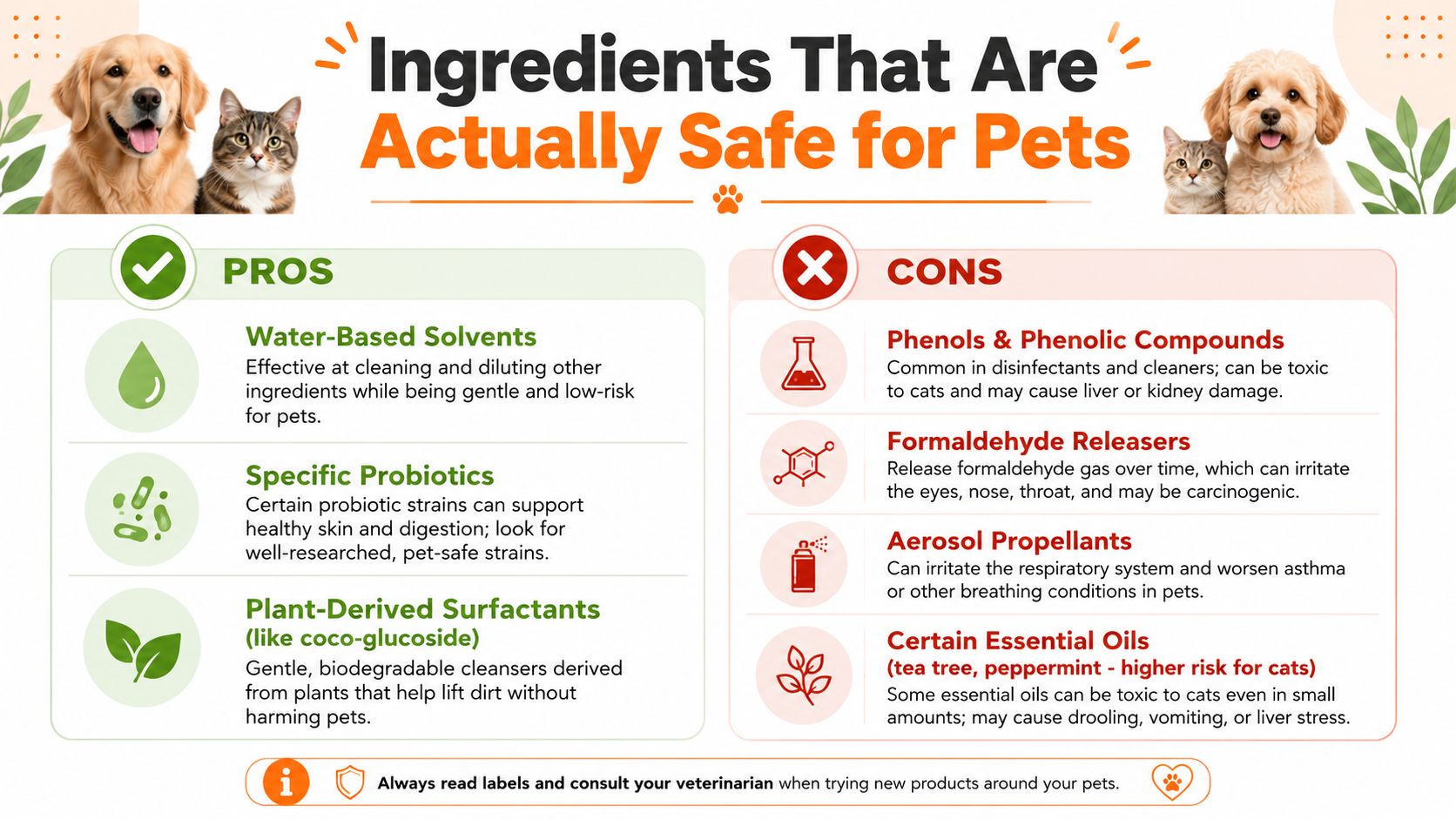
What to look for and what to avoid
Prefer:
- Water-based solvents: Usually easier to control on carpet than heavy fragrance systems.
- Specific probiotics or enzymes: Useful when the target is biological residue.
- Plant-derived surfactants: Ingredients such as coco-glucoside can support cleaning without relying on perfume alone.
Be cautious with:
- Artificial fragrance: It can irritate sensitive people and pets and may hide a problem.
- Phenols and phenolic compounds: These are a particular concern around cats.
- Chlorine, ammonia, and formaldehyde releasers: Avoid them for routine pet-odor treatment.
- Aerosol propellants: Don't use them around birds or in poorly ventilated rooms.
- Certain essential oils: Tea tree and peppermint are examples that deserve extra caution around cats.
A product guide should explain species-specific use, ventilation, drying, and whether pets must stay off the carpet. For more background before using scented products, consult this pet-safe essential oils guide.
Sunset Shine Home Cleaning uses non-toxic, eco-friendly products designed for homes with families and pets. You can also review dog-safe cleaning products before choosing a home routine.
How to Apply Carpet Deodorizer the Right Way
Application determines whether an enzyme product works or becomes another temporary scent. First identify the spot, remove loose debris, and test the formula on a hidden section of dyed carpet.
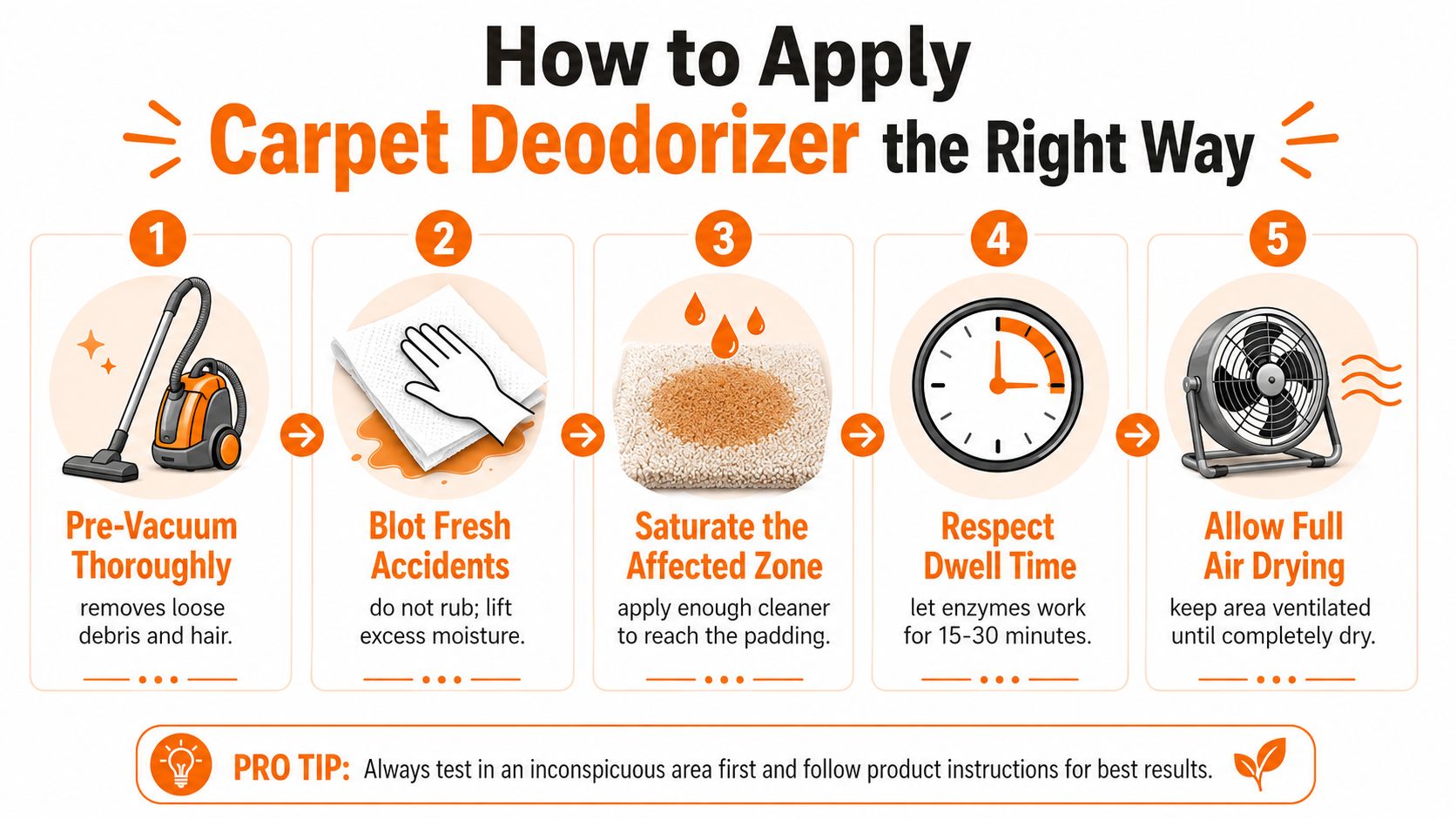
Follow the contact-time workflow
- Vacuum carefully. Remove sand, hair, and dry debris without grinding them into the pile.
- Blot fresh accidents. Lift moisture with towels. Don't scrub, because rubbing can push residue toward the backing.
- Saturate the affected zone. Apply enough product to reach the contamination, not just the visible top fibers.
- Allow dwell time. Enzyme guidance recommends at least 10 to 15 minutes of contact time, while some set-in spots need several hours or overnight to remain moist. Follow this pet-care application guidance.
- Blot and air-dry fully. Keep pets away until the carpet is dry and ventilate the room.
Don't steam-clean urine spots as a first response. Heat can set protein-based stains and odors into synthetic fibers. Avoid ammonia and vinegar for urine cleanup too, since strong smells may encourage a pet to return to the same area. See the urine-cleanup product guidance.
For a visual walkthrough, watch the embedded demonstration:
DIY Recipes That Actually Work in Palm Beach Homes
For routine freshness, vacuum the carpet thoroughly, sprinkle a light layer of baking soda, leave it briefly, and vacuum slowly. Baking soda can help with surface odors and moisture, but it won't digest urine proteins or solve padding saturation.
A second option is a cautious hydrogen-peroxide spot treatment for a light, set-in mark. Test a hidden area first, use a small amount of 3% hydrogen peroxide, leave it briefly, blot with a clean towel, and allow complete drying. Peroxide can lighten dyed fibers, so don't use it on wool or any carpet that fails the color test.
Know the stop line
DIY treatment makes sense when the accident is small, recent, and limited to the surface. It becomes a poor use of time when odor returns within hours, the spot is large, or the carpet feels damp below the pile.
Don't mix vinegar with baking soda expecting a stronger cleaner. The reaction mostly neutralizes the ingredients, and vinegar's sharp odor can complicate pet-resoiling behavior. Don't add essential oils to make a homemade spray smell stronger. For more context, see this guide to vinegar and baking soda cleaning.
How Often to Deodorize Based on Your Household
A busy Palm Beach rental with two dogs needs a different plan from a low-traffic condo with one indoor cat. Start with the conditions that create residue, including pet count, carpet age, AC runtime, tracked sand, and whether children spend time playing on the floor.
A practical maintenance rhythm
- Weekly: Vacuum high-traffic paths, entry areas, and pet resting zones. Address accidents immediately rather than waiting for a scheduled refresh.
- Biweekly: Inspect corners, under furniture edges, and areas near sliding doors where sand and moisture collect. Treat only spots that need biological odor control.
- Monthly: Review the whole carpet after a deep vacuum. A light surface refresh may be reasonable if the carpet is dry and there are no recurring hotspots.
A new puppy, an older cat, or a pet recovering from illness can require closer observation. Don't automatically apply more deodorizer to the entire room. Overwetting increases drying problems in humid weather and can leave residue that attracts more soil.
Odor returning within hours is a diagnostic clue, not a request for more fragrance.
Discoloration near the backing, repeated marking in one location, or a damp smell after drying points to a deeper problem. In those cases, a recurring cleaning plan can handle general dust, pet hair, baseboards, and high-touch surfaces while targeted carpet treatment addresses the source.
When to Call a Professional Carpet Cleaner
More spray won't solve padding saturation. It may add moisture, fragrance, and residue to a carpet that already needs extraction or inspection.
Call a professional when:
- The odor returns quickly: The source is probably below the surface or in the padding.
- One hotspot keeps coming back: The pet may still detect residue that people can't see.
- The carpet was repeatedly soaked: Excess moisture can create a slow-drying problem in South Florida humidity.
- A sick pet contaminated the area: Vomit, diarrhea, or urine may require broader cleaning than a small spot treatment.
- A landlord walkthrough is close: Move-out pressure isn't the time to discover odor in a bedroom corner or beneath furniture.
- An Airbnb turnover is tight: A room must dry, smell neutral, and look presentable before the next guest arrives.
Professional hot-water extraction uses controlled solution, agitation, and recovery to pull suspended soil and moisture from carpet. It can't guarantee that every contaminated pad is salvageable, but it can remove material that a surface spray leaves behind. A technician should inspect fiber type, dye stability, carpet age, and the likely depth of the accident before choosing a method.
Sunset Shine Home Cleaning handles one-time deep cleaning, recurring standard cleaning, move-in and move-out work, Airbnb and vacation-rental turnover, and property-management checklists across West Palm Beach, Palm Beach Gardens, Jupiter, Juno Beach, North Palm Beach, Riviera Beach, Royal Palm Beach, Lake Worth, Boynton Beach, Delray Beach, Boca Raton, Wellington, Westlake, Loxahatchee, Loxahatchee Groves, and The Acreage. The broader room reset includes bathrooms, kitchen degreasing, floors, baseboards, vents, fans, cabinet exteriors, window sills, mirrors, sinks, counters, fixtures, and high-touch surfaces, with add-ons such as inside ovens, refrigerators, cabinets, walls, pet-hair focus areas, and interior windows.
For property managers: A consistent checklist helps flag maintenance issues while crews prepare units for a final walkthrough or guest arrival.
Pricing depends on bedrooms, bathrooms, square footage, condition, and add-ons. Most clients request a custom estimate, especially when pet odor, move-out buildup, post-construction dust, or a tight turnover window is involved.
Book Sunset Shine Home Cleaning for a practical home reset that includes pet-hair focus areas, detailed bathrooms, floors, baseboards, and high-touch surfaces. Call 561-408-4020 or visit the site to request a quote for a one-time deep clean, move-out service, Airbnb turnover, or recurring cleaning in Palm Beach County.