
If you're staring at a wet ceiling, a soaked hallway, or a bathroom that's starting to smell off, you need a water damage cleanup service in West Palm Beach that can move fast and tell you whether cleanup is enough or the job has already crossed into structural restoration. In Palm Beach County, that call matters because mold can begin growing within 24 to 48 hours on wet materials, especially in homes that stay humid between AC cycles and rainy-season storms. A fast, measured response protects the property, the lease, and the insurance claim.
Table of Contents
- What a Water Damage Cleanup Service Actually Does
- The Professional Cleanup Process From Start to Finish
- Cleanup Versus Full Restoration and How to Know Which You Need
- Typical Timelines and Costs for Water Damage Cleanup
- Insurance Claims and What Homeowners Need to Know
- How to Choose a Reputable Local Water Damage Cleanup Provider
- Immediate Steps to Take Before the Cleanup Crew Arrives
What a Water Damage Cleanup Service Actually Does
A homeowner in West Palm Beach usually doesn't call because the whole house is underwater. More often, it starts with a leak under a sink, a broken supply line, or storm water creeping in around a door threshold. By the time the ceiling stain shows up or the baseboard swells, the visible water is only part of the problem.
What the work really includes
A real water damage cleanup service does more than mop and leave. The job starts with source control, then moves to extraction, drying, sanitation, odor control, and moisture verification. The point is to stop the loss from spreading into drywall, framing, insulation, and flooring that can trap moisture long after the surface looks fine.
Practical rule: If a contractor only talks about “drying it out” and never mentions moisture mapping or final verification, that's a weak sign.
In this climate, speed matters because wet materials don't stay wet politely. The EPA guidance cited in industry data says mold can take hold within 24 to 48 hours if damp materials aren't dried promptly, which is why response time is a real differentiator in South Florida. For a useful homeowner-facing guide on prevention after cleanup, see mold prevention strategies.
A good cleanup team will also know when the visible damage doesn't match the hidden damage. In a tile-floor home near the coast, water can run under baseboards, into wall cavities, or into padding under carpet where you'll never see it from standing eye level. That's why cleanup isn't about surface appearance, it's about returning the structure to a verified dry condition.
Bottom line: Cleanup handles the loss. Restoration handles the rebuilding that sometimes follows.
The Professional Cleanup Process From Start to Finish
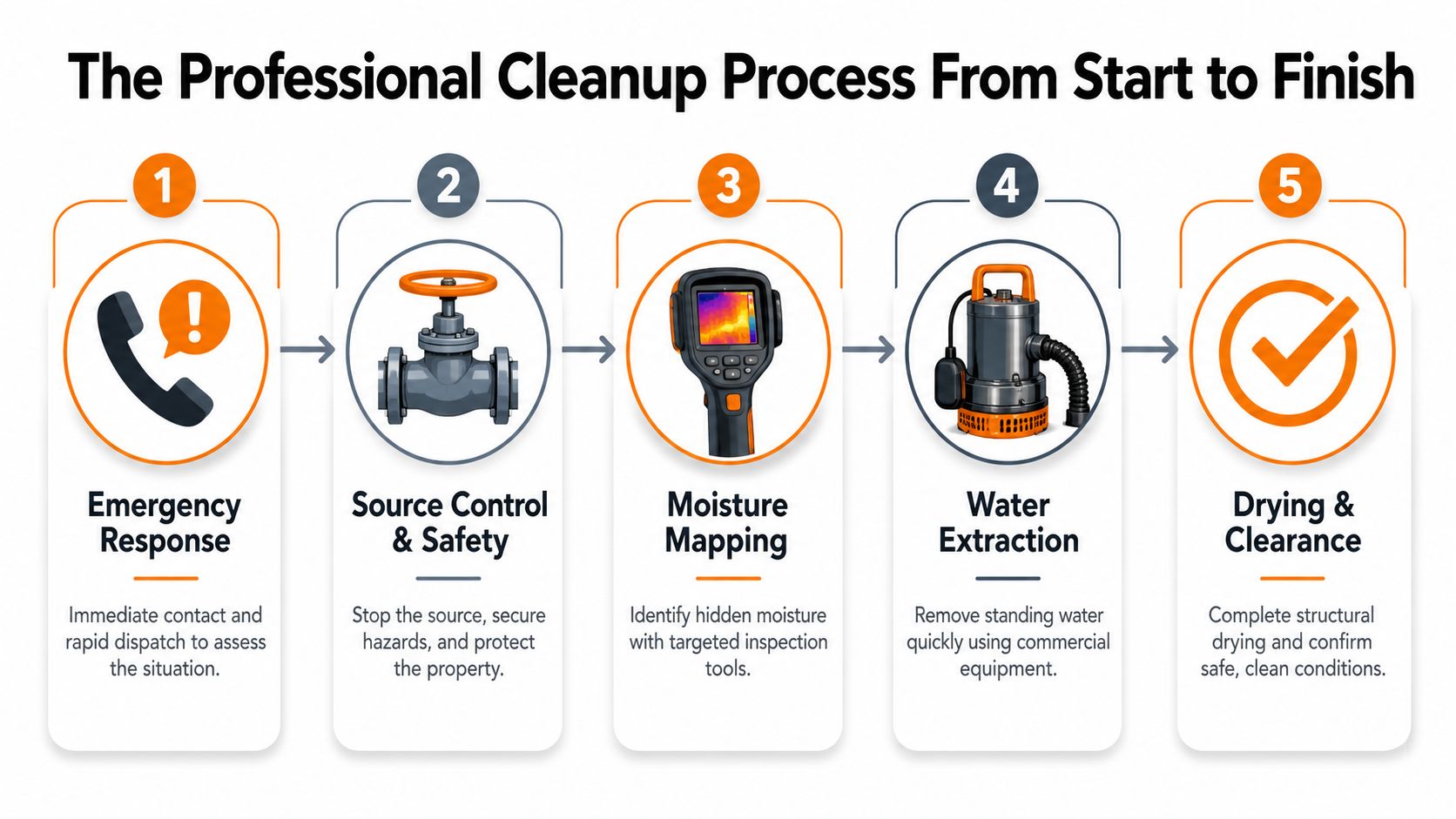
A crew that knows what it's doing doesn't guess at moisture, and it doesn't start with fans in every room. It begins by isolating the source, protecting electrical hazards, and deciding which areas need containment before a single drying machine goes in. That matters because the wrong setup can push contaminated air around or leave damp pockets hidden behind finished surfaces.
How the assessment should work
A technician should document temperature, relative humidity, dew point, and wet-bulb conditions in the damaged area and in unaffected reference areas. Then they should use penetrating meters for wood and drywall, plus non-penetrating meters and thermal imaging on concrete and tile, to build a moisture map. That's the difference between drying what you can see and drying the whole affected structure.
The classification also matters. Water is generally organized by category and damage class, and those labels guide containment, extraction, and equipment placement. A clean water loss from a supply line doesn't get treated the same way as contaminated water from a backup, and a small bathroom issue doesn't need the same footprint as a multi-room saturation event.
What happens after extraction
Once the water is removed with pumps, wet vacs, or truck-mounted extractors, drying equipment goes in. Air movers and dehumidifiers work together while readings are checked daily until the material reaches documented dry targets. A reputable provider should leave behind a dated floor plan, daily readings, and final moisture verification before equipment comes out.
For a nearby example of why drying details matter indoors, the same logic applies to air quality and filter upkeep, which is why many owners pair cleanup with air filter replacement service. Dirty filters don't cause the flood, but they can make a damp house feel worse while drying is underway.
What the homeowner should expect
- Clear communication: The crew should explain what's wet, what's being dried, and what may need removal.
- Daily monitoring: Moisture readings should change as the structure dries.
- No guessing: Visual dryness isn't the finish line.
- Final proof: The property should be confirmed dry before the equipment is removed.
Cleanup Versus Full Restoration and How to Know Which You Need
Not every water loss needs demolition, and not every drying job is enough. That boundary is where homeowners often get confused, because some contractors speak in broad terms while others jump straight to replacement. The right answer depends on how far the moisture spread, how long it sat, and what type of water got in.
The decision line that actually matters
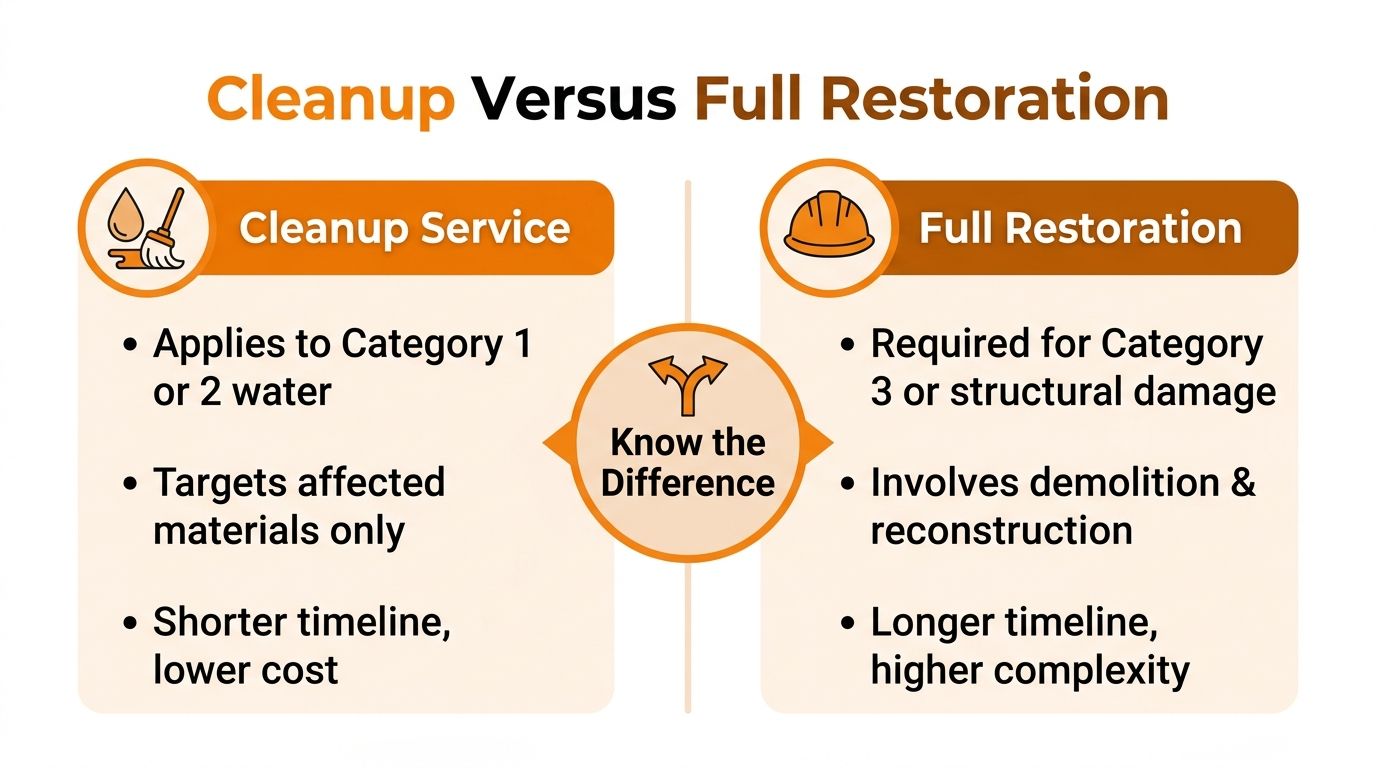
If the issue is caught early, contained to limited materials, and the affected building components can be dried without leaving hidden saturation, cleanup may be enough. If drywall, insulation, flooring, or framing stayed wet long enough to hold moisture after drying equipment has done its job, then repair or replacement starts to make more sense.
Practical rule: If porous materials can't be verified dry, they can't be treated as if they're safe just because the surface feels better.
Water category matters too. Clean supply water is one thing. Gray or contaminated water changes the job because sanitizing, containment, and sometimes removal become part of the scope. That's also where a homeowner should ask for a clear explanation of what's being saved and why.
Questions that cut through the sales pitch
Ask these before approving bigger work:
- What materials are salvageable, and what tells you that?
- What moisture readings support your recommendation?
- Are you proposing cleanup, repair, or both?
- Which parts are being removed because they're unsalvageable, not just because they're inconvenient?
A solid company can answer those questions without turning vague. A weak one leans on fear or pushes reconstruction before showing evidence. The Home Depot guide on full guide water damage restoration is useful here because it reinforces the practical boundary between mitigation and later repair.
In Palm Beach County, that distinction matters because humidity can keep a marginal material wet longer than people expect. A quick cleanup might save a vanity toe-kick or a section of trim, but a soaked wall assembly in a closed, air-conditioned home is a different story.
Typical Timelines and Costs for Water Damage Cleanup
For most homeowners, the biggest surprise isn't the mess. It's how long the drying takes once the water is gone. Standing water extraction can happen quickly, but the structure itself often needs days of monitored dehumidification before anyone should call it finished.
What timeline to expect
Industry references commonly place drying and dehumidification in a range of 3 days to 2 weeks, depending on saturation and material type, with more severe losses taking longer. A small leak under a vanity behaves differently from a soaked hallway, and a finished room with drywall and carpet is more involved than a tile area with limited absorption. For homeowners, that means the calendar is driven by materials, not just by the amount of visible water.
| Severity Level | Typical Drying Time | Common Scenarios |
|---|---|---|
| Minor | 1 to 3 days | Small leak, limited floor area, fast discovery |
| Moderate | Several days | Multiple rooms, damp drywall, carpet padding, trim |
| Major | 5 to 7 or more days | Flooding, structural drying, larger saturation spread |
The drying phase is the control point because extraction alone doesn't stop hidden moisture from feeding later damage. A hallway can look passable in an afternoon and still hold enough dampness in the wall base or padding to cause trouble later.
What affects cost
Pricing depends on square footage, water category, materials involved, and whether contents need to be moved or stored. A bathroom leak is not priced like a multi-room storm event, and contamination changes the scope again. One industry summary reports the U.S. water damage restoration market at $8.5 billion in 2023, projected to reach $11.2 billion by 2028 at a 5.2% CAGR (worldmetrics.org), which reflects how much work sits inside this segment. Another source says climate change has increased restoration costs by 22% since 2018 on that same page, and that reality shows up in the growing complexity of severe losses.
For a local homeowner, the practical answer is simple. Get a written estimate tied to moisture readings and the actual scope, not a generic “dryout” number.
Insurance Claims and What Homeowners Need to Know
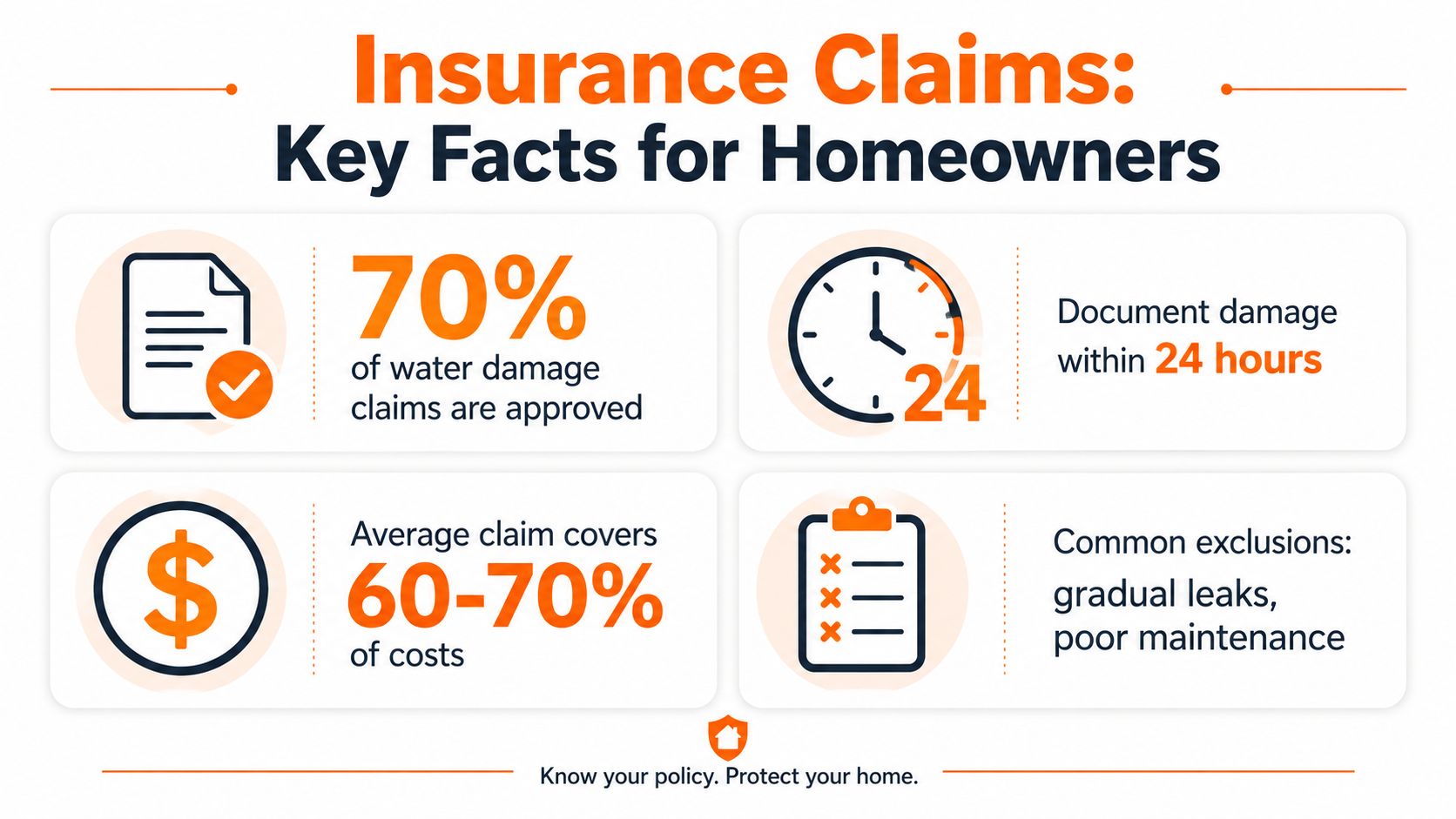
Water damage is one of the most common insurance headaches homeowners face, which is why the paperwork needs to be clean from the start. Industry data shows about 1 in 60 insured homes files a water damage or freezing claim each year, and water damage and freezing made up nearly 28% of homeowners losses in 2022. Another source reports 22.6% of all homeowners insurance losses in 2023 came from water damage and freezing, which tells you this isn't a rare event, it's a regular part of property ownership. See also the homeowner resource on flood damage coverage in Florida when you need a separate read on coverage boundaries.
What claims usually hinge on
Sudden accidental losses are often easier to document than slow leaks and poor maintenance issues. Adjusters want to see the source, the extent, and the sequence, especially when the loss spreads into walls or cabinetry. Keep receipts, photos, dates, and any communication with the mitigation team so the timeline stays clear.
What to document right away
- Photograph the source: Show the leak, intrusion point, or flooded area before anything moves.
- Capture the spread: Take wide shots and close-ups of affected rooms, materials, and contents.
- Save receipts: Keep every invoice tied to emergency mitigation and follow-up work.
- Write down timing: Note when you found the water and when service started.
If you're dealing with a claim in Palm Beach County, the cleanest file is the one that shows what happened, what was done, and what remained after mitigation. That helps the adjuster see why cleanup was necessary and where repair might begin.
How to Choose a Reputable Local Water Damage Cleanup Provider
The right provider in West Palm Beach should sound calm, specific, and organized on the first call. They should understand South Florida construction, fast-drying needs in humid homes, and the difference between a minor kitchen overflow and a storm-driven intrusion that spreads through several rooms. A company that works here every week will ask different questions than a generic emergency line.
What to look for
A reputable provider should be able to explain whether they use moisture mapping, how they document daily readings, and how they handle final verification. They should also have clear licensing and insurance, and they should be willing to coordinate with an adjuster without turning the job into a maze of callbacks.
Questions worth asking before you book
- Do you provide documented moisture readings?
- Can you describe the drying plan in plain English?
- Will you tell me what should be repaired versus what can be cleaned?
- How fast can you respond if the leak is active?
- Can you work with my insurer's documentation process?
Red flags are easy to spot once you know what matters. Watch for vague pricing, no written estimate, no moisture documentation, or a company that acts like every wet wall needs full rebuild. The best teams don't oversell, and they don't disappear after the extraction truck leaves.
Local reality: Palm Beach County homes fight humidity, AC cycling, salt air, and storm-season moisture at the same time. A provider who ignores that usually misses the part that comes back later.
Immediate Steps to Take Before the Cleanup Crew Arrives
The first hour matters, but safety comes first. If water is near outlets, appliances, or the panel, keep people and pets away from the area and shut off power to the affected space if it's safe to do so. If you can stop the water source, do that next, because every minute of flow makes the scope worse.
What to do right away
Move valuables, papers, and electronics to a dry room. If the water is clean and shallow, blot it up with towels or use a wet vacuum if you have one. Take photos before you shift too much, because your insurer will want to see the scene as it was found.
What not to do
Don't run household fans on contaminated water. Don't scrape at visible mold or tear into wet drywall just to see what's behind it. If the material is already saturated, rough handling can spread debris and make the repair larger than it needed to be.
For a quick reference while you wait for help, the guide to water damage recovery 2026 covers practical first steps in emergency conditions. That's useful, but in Palm Beach County the harder part is usually what comes after the first response, especially when humidity hangs in the structure.
If the wet area is near a slab, garage, or lower level space, the moisture problem can linger along the base of the structure longer than people expect. For that reason, a follow-up look at basement moisture control can help homeowners think about recurring dampness after the emergency is handled.
Book your cleaning with Sunset Shine Home Cleaning, your trusted house cleaning service in West Palm Beach. Call 561-408-4020 or book online, sunsetshinehomecleaning.com.