
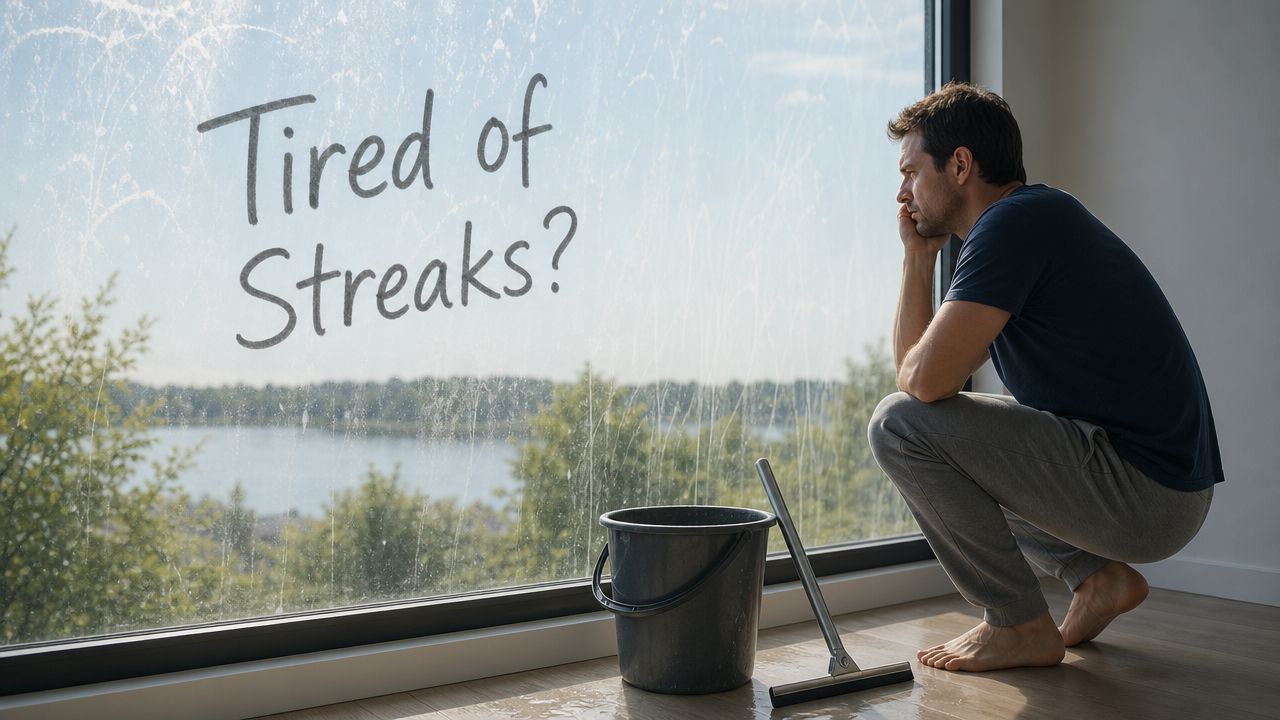
You're probably here because the glass looks fine from across the room, then the Florida sun hits it and every streak, pollen smear, and salty film shows up at once. That's the promise of automatic window cleaning. Push a button, skip the ladder, and hope the machine handles it.
For some homes, it helps. In Palm Beach County, it usually falls short once you factor in humidity, coastal residue, tropical pollen, sandy sills, and the grime that collects where glass meets tracks and frames.
Table of Contents
- What Is Automatic Window Cleaning
- How Do Window Cleaning Robots Work
- The Pros and Cons of Automated Window Cleaners
- Why Robots Struggle with West Palm Beach Windows
- Professional Cleaning vs DIY Automation When to Choose
- Common Questions About Window Cleaning Solutions
What Is Automatic Window Cleaning
If you live in West Palm Beach, Palm Beach Gardens, Jupiter, or Juno Beach, your windows don't stay clean long. Salt in the air, sticky pollen on the sill, and that film that builds up after a humid week make even newer glass look dull fast.
Automatic window cleaning usually means a robotic device that sticks to the glass and wipes it for you. Think of it as a window version of a robot vacuum. You place it on the pane, turn it on, and it moves across the surface using built-in navigation.
The category is growing for a reason. The Technavio robotic window cleaner market outlook projects the global market will expand by USD 5.40 billion from 2026 to 2030, with a 29.7% CAGR driven by smart home automation and labor-saving demand.
Why people are interested
Homeowners usually look at these machines for a few practical reasons:
- Safer upper-window cleaning when they don't want to climb a ladder
- Less hands-on effort for routine glass maintenance
- Smart-home appeal for people already using automated devices
- Quick touch-up potential on standard interior glass
Practical rule: If your window mostly has light dust or fingerprints, a robot may be useful. If it has salt film, heavy grime, dirty tracks, or mildew around the frame, it won't replace real cleaning.
What these machines are actually cleaning
This part matters. Most robots clean the glass pane only. They don't solve the bigger mess around the window. In Palm Beach County homes, that often means the visible dirt is only half the problem. The sill catches pollen, the track traps dark buildup, and the frame holds onto moisture.
That's why the marketing sounds better than the day-to-day result in South Florida houses, condos, and short-term rentals.
How Do Window Cleaning Robots Work
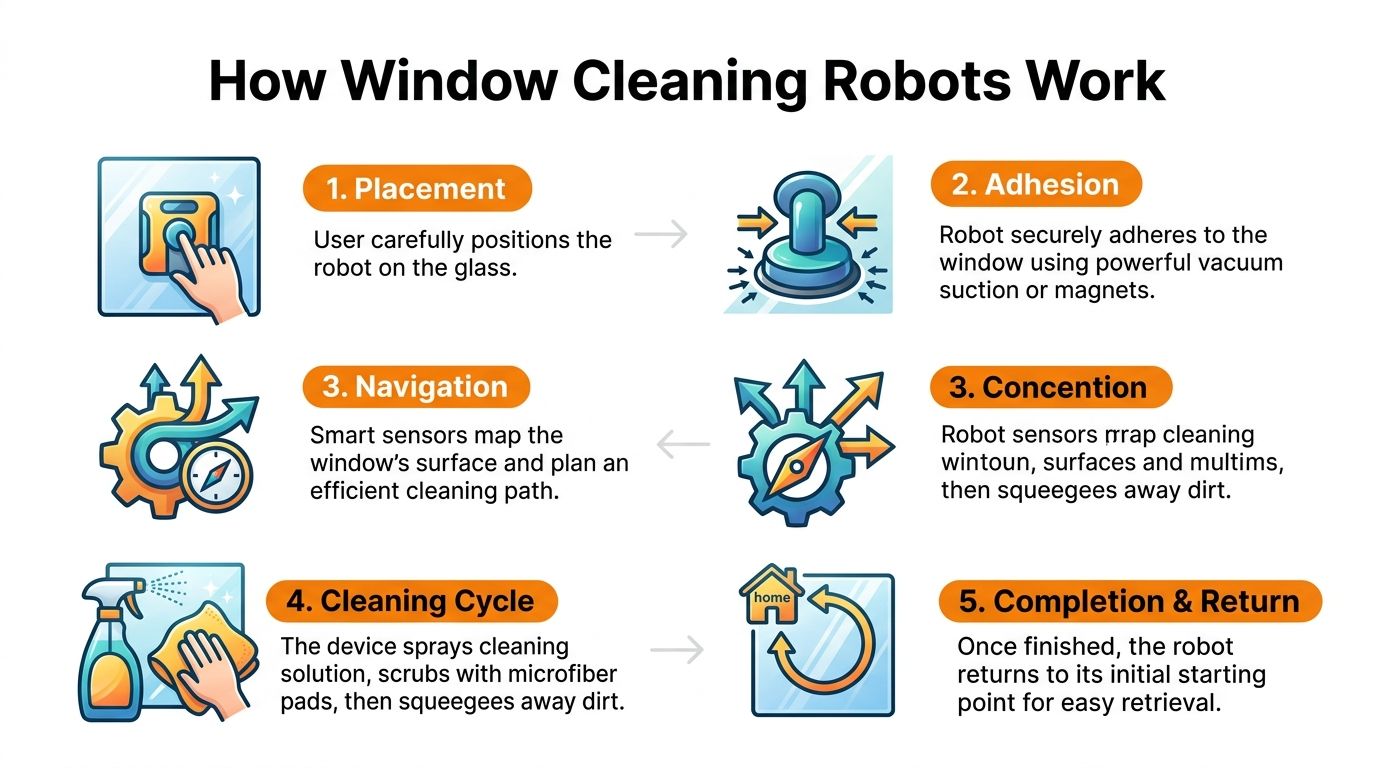
The easiest way to understand them is this. They're basically a Roomba for vertical glass. They attach to the window, follow a path, wipe as they go, and return when they finish.
How they stay on the glass
Most units use one of two methods:
- Vacuum suction that pulls the machine against the pane
- Magnetic systems that rely on paired components across the glass
For typical home use, suction models are what comes to mind. They're designed to cling to vertical glass while the pads move underneath.
What happens during a cleaning cycle
A normal cycle looks like this:
Placement
You position the robot on the window and power it on.Attachment
The unit locks onto the glass using suction or magnet-based force.Surface mapping
Sensors help it detect edges and follow a route across the pane.Wiping and spraying
The robot uses pads and a small amount of cleaning fluid while it moves.Return
Many models finish by heading back toward a starting point.
The core cleaning hardware is straightforward. According to the Dataintelo automatic window cleaning system report, these systems typically use microfiber pads paired with ultrasonic spray nozzles, and that combination removes 90 to 95% of surface contaminants on standard glass without human intervention.
Here's the video version if you want to see the movement in action.
Where the mechanics hit a wall
The problem isn't that the machine does nothing. It's that it does one narrow task. It wipes flat glass under fairly controlled conditions.
A robot follows its pattern. It doesn't stop and scrub the one corner where pollen paste built up after a storm.
That matters in homes around North Palm Beach, Royal Palm Beach, and Wellington where screens, tracks, frames, and sills collect more grime than the center of the glass.
The Pros and Cons of Automated Window Cleaners
A robot on the glass looks impressive the first time you use it. Then a South Florida rain blows through, the humidity stays high, and the windows still show a film around the edges by afternoon. That gap between the sales pitch and the actual result is the whole story.
Where they make sense
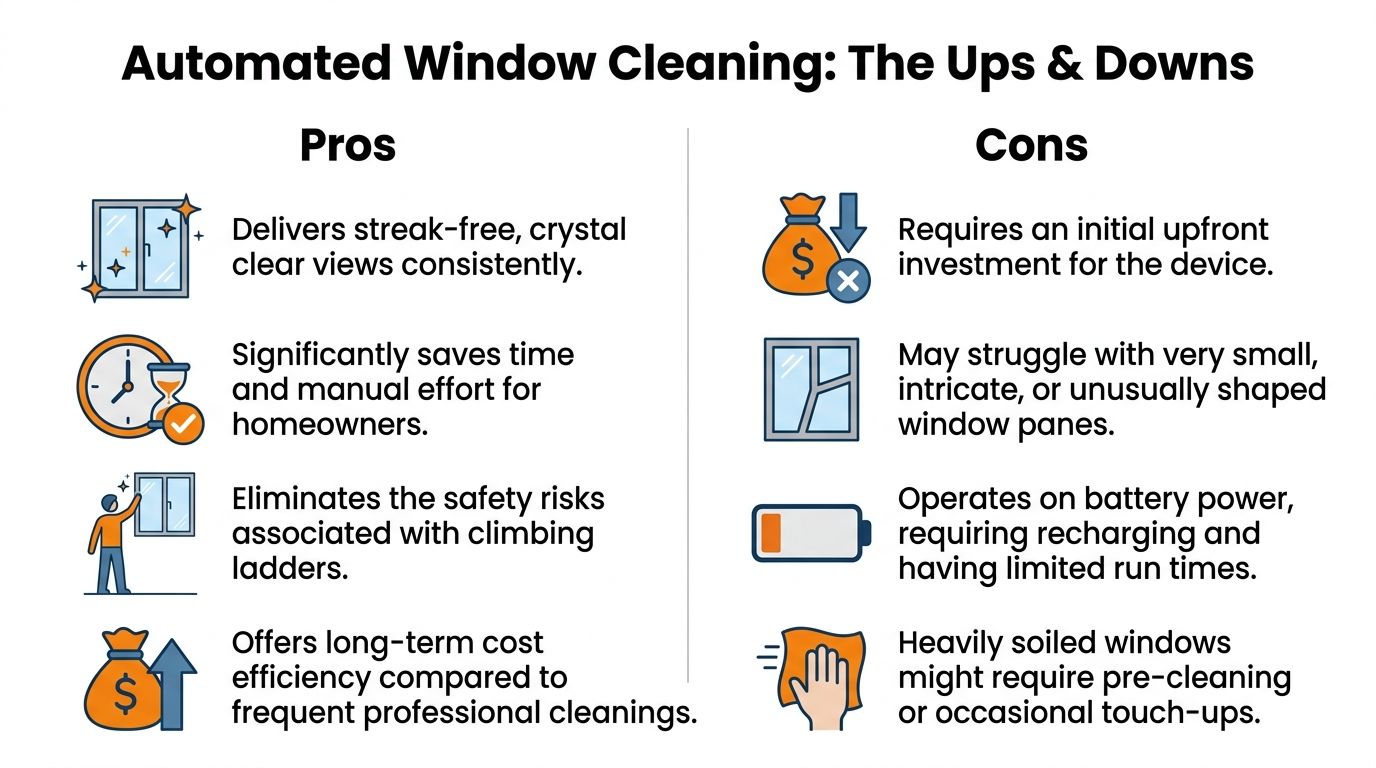
Automatic cleaners are best used as maintenance tools, not as a replacement for real window cleaning. If your glass is already in decent shape and you want help with light dust, fingerprints, or a quick refresh between service visits, they can save time.
They are a reasonable fit for:
- Upper panes you do not want to reach by ladder
- Interior glass with light smudges
- Routine touch-ups between deeper cleanings
- Flat, accessible windows with mild surface soil
That is the right expectation. Keep the glass presentable. Cut down on light wiping. Avoid a few trips up and down a ladder.
Some large commercial systems also make sense on high-rise buildings where speed and worker safety matter more than detailing. That use case is very different from a home in West Palm Beach, where the problem is usually not the middle of the pane. It is the residue, edges, and surrounding buildup that collect in humid, salty air.
Where they fall short
Homeowners get disappointed when they expect a polished, whole-window result. Robots do not deliver that, especially outside.
Here is where they come up short:
Heavy grime stays put
Salt haze, stuck-on pollen, rain spotting, bug marks, and old residue usually need hand scrubbing.They clean glass, not the full window
Tracks, frames, locks, corners, and screens still need manual work. If grime is building up below the pane, clean window sills properly or the whole window area will still look dirty.They depend on favorable conditions
Light soil on flat glass is fine. Sticky buildup after storms, ocean air, and wet season grime are not.They miss the details your eye catches first
Edge residue and corner buildup stand out fast in bright South Florida sun.
The bigger problem is marketing. Product pages push a near-perfect clean. Real homes in Palm Beach County rarely give a robot that kind of surface to work with. Salt spray leaves film. Humidity helps grime cling. Pollen turns into paste once moisture hits it. A machine that follows a pattern cannot stop, inspect, and work a trouble spot until it is gone.
My candid take
Do window cleaning robots work. Yes, for light maintenance on fairly clean glass.
Would I count on one for exterior windows in this area. No.
If you want the windows to look acceptable for a few days, a robot can help. If you want glass, edges, frames, and sills to look spotless in a coastal Florida home, manual cleaning wins every time.
Bottom line: Robotic cleaners are fine for upkeep. Professional hands still do the job right.
Why Robots Struggle with West Palm Beach Windows
Local reality proves critical. A robot tested on smooth, lightly dusty glass is one thing. A window in Jupiter after salt air, summer humidity, and blowing rain is something else.
Salt spray isn't a light wipe job
In coastal areas, the issue isn't just visible smudging. It's the film left behind on glass, fixtures, sills, and surrounding surfaces. Coastal homes in West Palm Beach, Jupiter, and Juno Beach can experience salt air corrosion within 6 to 12 months if those areas aren't cleaned with non-acidic, pH-neutral solutions, and robots aren't equipped to handle that kind of detail work. For the surrounding buildup that machines miss, proper window sill cleaning matters just as much as the glass itself.
That's common in condos near the water and in homes west of the Intracoastal that still catch coastal air patterns. You'll see the haze first on sliders and exterior-facing panes, then along the edges and hardware.
Palm Beach County grime collects where robots don't clean
The center of the pane is rarely the dirtiest part here.
What usually needs real elbow grease:
- Sills with yellow-green pollen paste after windy mornings
- Tracks with black grime from moisture and trapped debris
- Bathroom windows with mildew spotting from high humidity
- Entry glass with handprints and rain splash during wet season
- Frames and fixtures with salt residue that needs the right solution
In houses around Palm Beach Gardens and The Acreage, you also get a different mix. More dust, more blown debris, and more screens and tracks holding onto buildup after storms.
Clean glass still looks dirty when the sill is gritty and the track is dark. That's a daily South Florida problem.
The local issue nobody should ignore
Palm Beach County humidity changes the cleaning job. It helps dirt stick. It feeds mildew in damp areas. It turns pollen and fine dust into a film instead of a dry layer you can lightly wipe away.
That's why automatic window cleaning sounds smarter on paper than it looks in many local homes.
Professional Cleaning vs DIY Automation When to Choose
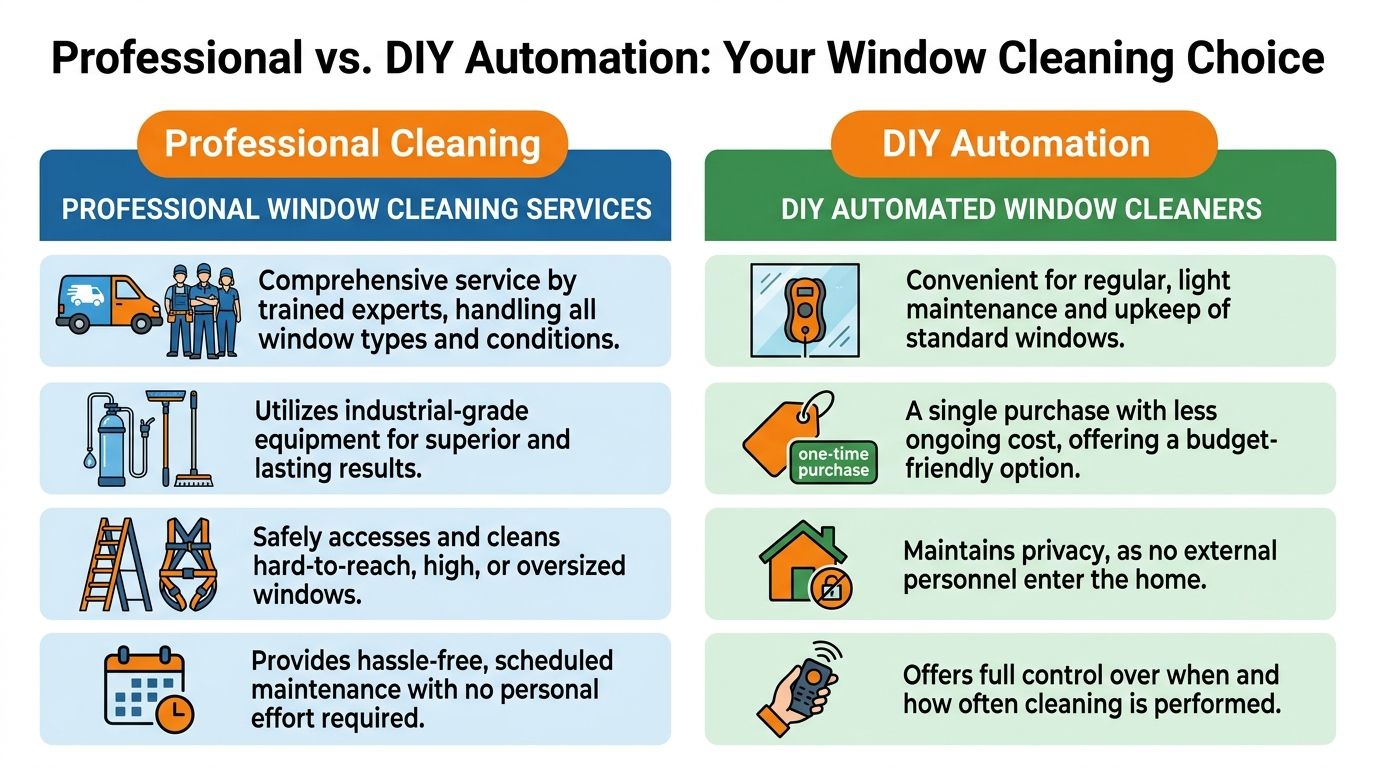
Choose the tool based on the result you need. If you only want a quick pass on glass that already looks decent, a robot can help. If you want the whole window area to look completely clean in South Florida, manual service is the better call.
Choose DIY automation for light upkeep
Use a robot for maintenance, not rescue work.
It fits a small, specific job:
- Your glass is already in good shape
- You want a between-cleanings touch-up
- The panes are flat, standard, and easy for the device to cover
- You are fine leaving the tracks, sills, frames, and edges alone
That can work well enough on interior glass or on a pane that just picked up light fingerprints.
Choose professional cleaning when results matter
Book a pro when appearance matters, time is tight, or buildup is obvious.
Manual cleaning is the right choice for:
- Salt film on exterior glass
- Sticky pollen residue
- Listing photos or showing prep
- Short-term rental turnovers
- Storm residue on panes and sills
- Tracks and corners that have been ignored for months
Our experience with short-term rentals in Boynton Beach and Delray Beach is pretty consistent. Hosts and cleaners do not judge the job by the middle of the glass alone. They look at the lower corners, the slider tracks, the sill, and the spots guests notice in natural light. That is exactly where robots fall short. For fast, complete results, a dedicated professional window cleaning service is the smarter option.
A real South Florida decision guide
Use this quick test:
| Situation | Best choice |
|---|---|
| Light fingerprints on interior glass | Robot |
| Exterior sliders with visible coastal haze | Professional |
| Gritty tracks and dirty sills | Professional |
| Basic touch-up on one standard pane | Robot |
| Rental turnover or open-house prep | Professional |
A robot cleans the pane. A person cleans what everyone sees.
That difference shows up fast in Boca Raton, Delray Beach, and Lake Worth homes. Clean glass with dusty sills still looks rushed, especially in bright afternoon sun and high humidity.
Common Questions About Window Cleaning Solutions
Are robotic window cleaners expensive
Yes, and the price makes less sense once you look at what they leave behind. You are paying for pane-only maintenance, not a full window-area clean. That matters in West Palm Beach, where salt film, humidity, and pollen turn a simple wipe into a detail job.
A robot can help with light touch-ups on suitable glass. It does not replace hands-on cleaning of edges, tracks, frames, and sills.
Do they work on frameless glass and big sliders
Sometimes, but only under the right conditions. Large sliders and frameless panels look like an easy win for a robot until South Florida residue gets involved. Salt haze clings to the outer glass, pollen gathers along the perimeter, and the lower sections pick up grime that needs pressure, rinsing, and judgment.
They don't adapt like a person does when one panel is lightly dusty and the next has sticky buildup near the seals.
What should a complete window-area cleaning include
Clean glass alone is not enough. A proper job should include the pane, edges, frames, tracks, sills, and the residue that collects in corners and along slider channels. If the product choice matters to you, start with a safer eco-friendly glass cleaner method that cuts grime without leaving harsh residue behind.
That is the difference between a window that looks clean from across the room and one that still looks dingy in direct afternoon sun.
How often should South Florida homes clean windows
More often than people expect. Homes near the water need more attention because salt spray keeps settling back onto the glass. Homes with patio sliders, pets, kids, frequent backyard use, or rental guest traffic also get dirty faster.
In this climate, buildup is rarely just dust. It gets sticky, gritty, and obvious fast.